
Why AI Rewriting Makes Simple Sentences Sound Too Formal
AI rewriting can make a simple sentence sound formal because the tool interprets "better" as more polished, elaborate, or cautious. A request to improve wording can replace ordinary verbs, expand short phrases, and add qualifications the writer never intended.
The effect isn't universal. It depends on the model, the instructions, and the selected style, but unnecessary formality becomes a problem when polish obscures meaning. The useful distinction is between edits that clarify a sentence and edits that merely dress it up.
Key Takeaways
Vague requests for improvement leave tools free to change the register, rhythm, and certainty of a passage.
Inflated vocabulary, automatic transitions, passive constructions, and excess hedging can make clear writing harder to follow.
A reliable revision process protects facts and qualifications first, then judges whether each stylistic change fits the writer's voice.
Why AI Rewriting Often Favors Polished Prose
Language models use natural language processing techniques to generate text from patterns learned during training and instructions supplied during use. They don't have an independent understanding of which version sounds like a particular writer.
When a prompt says "make this professional," a model can produce language associated with reports, business correspondence, or academic explanations. That may fit a procurement document. It may sound awkward in an ordinary email.
The instruction also leaves "professional" undefined. It could mean accurate and courteous, or distant and ceremonial. Without an audience or sample, the tool has room to choose the wrong interpretation.
A sentence rewriter can face a practical tension: an unchanged sentence can look like an uncompleted task. Yet some sentences already say exactly what they need to say. A useful edit may involve deleting one word or changing nothing.
This explains why repeated rewriting can make prose worse. Each pass supplies more opportunities to replace familiar wording and flatten individual choices. The same problem appears when generic AI phrasing replaces specific language.
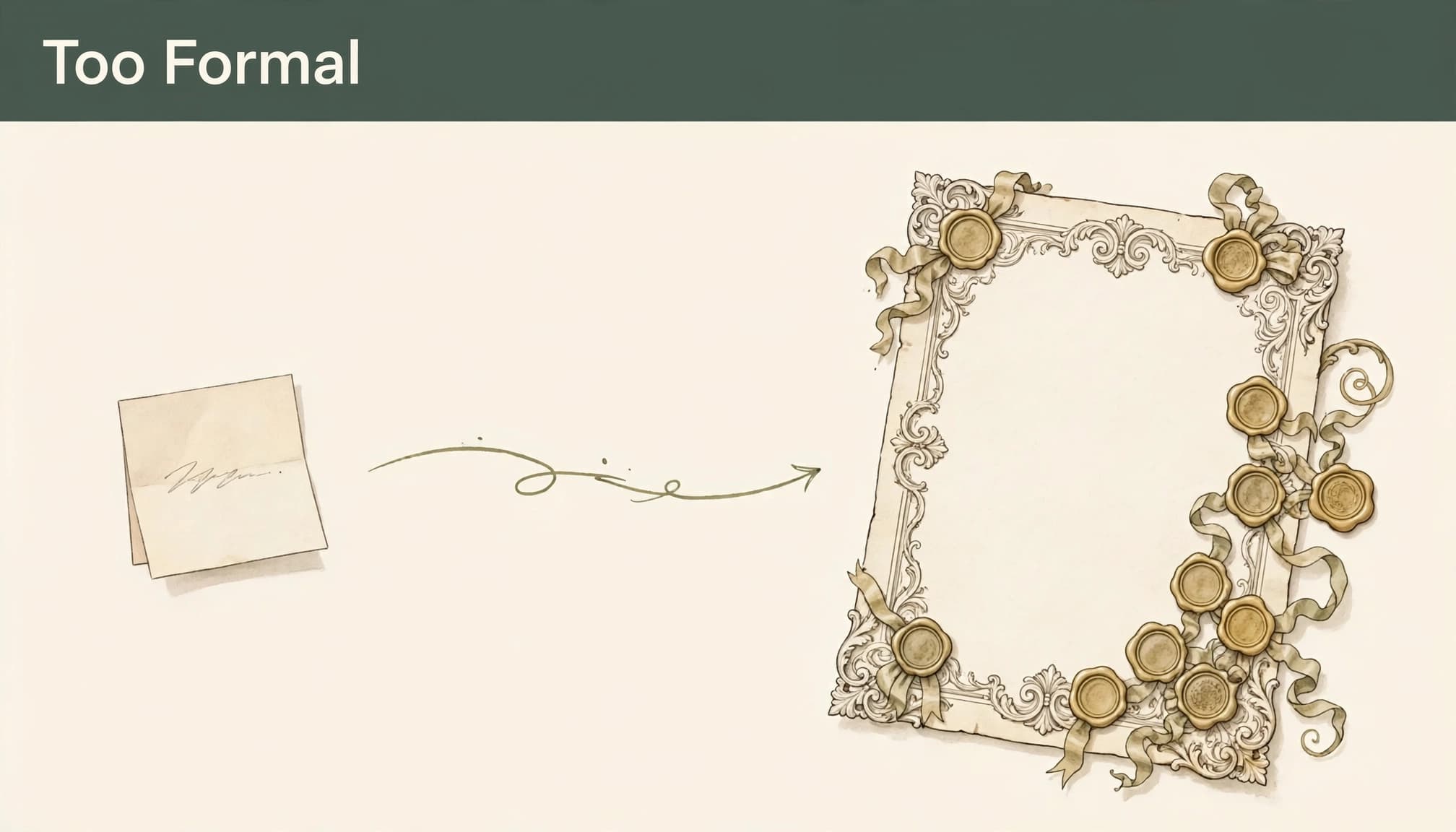
Four Edits That Make Plain Sentences Sound Formal
Inflated vocabulary
Before: "We used the new template."
Overformal rewrite: "We utilized the new template."
"Utilized" is a longer synonym for "used," but it doesn't add information or make the sentence more precise. Familiar words such as "use," "help," and "start" usually work unless a technical distinction requires something else. More syllables don't establish greater precision.
Unnecessary transitions
Before: "The file is ready. I'll send it today."
Overformal rewrite: "The file is ready. Therefore, I will proceed with sending it today."
The rewrite adds ceremony and spells out a connection that was already apparent. Transitions help when they explain a real contrast, cause, or sequence. Attached automatically, they slow the paragraph and make every step sound like a formal argument.
Passive constructions
Before: "I changed the date."
Overformal rewrite: "An adjustment was made to the date."
The revision hides the actor and replaces a direct verb with an abstract noun. Passive voice remains useful when the actor is unknown or irrelevant. Here, however, the original identifies responsibility in fewer words.
Excessive hedging
Before: "This version fixes the error."
Overformal rewrite: "This version may potentially help address the error."
The rewrite changes certainty, not just tone. If the fix is established, the hedge weakens an accurate statement. If testing remains incomplete, caution belongs in the original claim. Removing every qualification would create the opposite error.
Free AI Rewriters: Styles and Limits
A free AI tool or free online tool can offer different controls, but a style label doesn't establish rewrite quality. Judge a ChatGPT Rewriter by its controls and output, not its label. The most relevant features constrain unwanted changes.
Tool | Available controls | Limits and practical details |
|---|---|---|
Canva Magic Write | Sentence rewriting | Documented input limit of 200 words and output of around 500 words; output may stop mid-sentence. |
Evernote Reword | Friendly, Formal, Funny, Concise, Engaging, Empathetic, plus the HumanLike style | No custom styles. File upload supports .txt, .md, .json, .csv, and .jpg or .png images through OCR, with a 100 MB file limit. |
Scribbr Paragraph Rewriter | Synonym replacement and paragraph revision | Free and ad-free, with document uploads and a 125-word limit per paragraph. |
Quillbot Paragraph Rewriter | Free Standard and Fluency styles | Also offers an AI Humanizer intended to reduce robotic patterns. |
Evernote describes the HumanLike style as a conversational option intended to avoid robotic patterns. However, conversational language still needs an audience: a research abstract and a message to a colleague require different choices.
Canva's dated guidance lists 20 supported languages as of March 22, 2023, and a data boundary of mid-2021. That historical knowledge limit matters when rewriting factual material: a stylistic revision doesn't update the underlying information.
For a long document, paragraph-sized sections make source comparisons easier. Terminology and voice instructions need to remain consistent across sections. Otherwise, individually smooth paragraphs can produce an uneven article.
A Practical Workflow That Preserves Voice
A narrower request gives a rewriter fewer chances to overwrite useful choices. Ask it to rewrite text only for a named problem, rather than making a general request for improvement.
Identify the problem.
Name the repetition, tangled sentence, grammar error, or mismatch in tone. A request to remove repeated phrases is more controlled than "make this better."
Protect the content.
Keep names, figures, citations, technical terms, negation, and qualifications unchanged. Mark quotations as text that must remain exact.
Supply voice evidence.
Include a short approved sample and describe the writing style it should preserve, such as contractions, ordinary verbs, or restrained humor. Name the audience and purpose to guide context-aware rephrasing.
Compare and select.
Accept individual improvements rather than replacing the entire original automatically. Read the resulting paragraph aloud for awkward rhythm.
A suitable instruction might read:
"Edit for clarity using everyday vocabulary. Keep contractions and preserve every fact, citation, condition, and degree of certainty. Don't add transitions unless they clarify a relationship. Leave effective sentences unchanged."
A short voice sheet can record preferred vocabulary, typical sentence length, and acceptable levels of formality. These are observable choices, rather than vague requests to sound authentic.
Natural rhythm also requires judgment. A mix of short and longer sentences can improve readability, but forced variation becomes another pattern. A short sentence should remain short when its job is complete.
Meaning Needs a Separate Review
Preserve exact details
A fluent rewrite can conceal a changed date, rounded percentage, missing citation, or altered unit. Those details need comparison against the original, regardless of how natural the revision sounds.
Literal checks work well for numbers, names, hyperlinks, and quoted wording. However, matching those elements doesn't prove that the surrounding statement survived. A rewrite can retain "Friday" while changing a Friday deadline into an expected delivery date.
Preserve the full claim
Words such as "may," "only," "unless," and "some" define a statement's boundaries. They aren't expendable clutter. "Helped organize" also describes a different role from "founded," even when both versions sound plausible.
Effective testing for meaning drift therefore compares responsibility, certainty, conditions, and scope as well as exact values. Medical, legal, financial, and scientific passages require especially strict review because a small wording change can alter the advice or obligation.
Rewriting Doesn't Remove Attribution or Copyright Duties
Rewriting usually changes wording, structure, and tone. A paraphrase more narrowly restates a source, sometimes to make it easier to understand. The terms overlap, but both require fidelity to the original idea.
Rewriters commonly help with grammar, repetition, audience-appropriate tone, and drafts produced by ChatGPT or Claude. People also use them to avoid plagiarism. Changing wording alone doesn't resolve plagiarism or attribution concerns, establish originality, or prevent duplicate content. SEO review still needs to check sources and distinct information.
Copyright presents a separate question. The U.S. Copyright Office's report on generative AI training examines copyrighted works in model development. That issue differs from permission to reuse a particular source passage.
Canva says it doesn't claim copyright over Magic Write output. That doesn't establish that the user owns the output or receives exclusive rights.
Likewise, a detector score can't establish authorship or originality, confirm permission, or show that meaning was preserved. Editorial quality depends on the text and its evidence, not a classification result.
Frequently Asked Questions
Which AI is best for rewording without sounding formal?
There isn't a supported universal winner. The relevant distinction is control: explicit tone settings, editable suggestions, and instructions that preserve existing wording can help limit unnecessary changes.
A grammar correction may be enough for a local error. A broader rewrite fits structural repetition or an unsuitable register. Understanding rewriting versus grammar editing helps prevent a small problem from becoming an unnecessary overhaul.
Can an AI rewriter change casual writing to a formal tone?
Yes. Formal presets and explicit instructions can change vocabulary, contractions, sentence structure, and distance between writer and audience.
That capability also explains accidental over-formality. A request for "professional" writing can prompt wider changes than intended. Naming the audience and limiting the editing task gives the instruction a clearer boundary.
Does every AI rewrite change the original meaning?
No. Many revisions correct errors or improve flow while retaining the message. However, meaning preservation is an editorial requirement, not an automatic consequence of fluent wording.
The useful comparison asks whether the same person did the same thing, under the same conditions, with the same degree of certainty.
Clear Writing Needs Fewer Unnecessary Changes
Simple sentences become overly formal when a rewrite substitutes visible polish for a defined editorial purpose. Longer vocabulary and cautious phrasing can be appropriate, but they need a reason to appear.
The strongest revision preserves meaning and voice while removing a real obstacle to understanding. Sometimes that requires restructuring a paragraph. Sometimes the clearest sentence is the one the tool leaves alone.