
How to Edit AI Crisis Statements Before Public Release
AI crisis statements need separate reviews for evidence, public impact, legal risk, and human accountability before publication. A fluent draft can contain an invented figure, an unsupported reassurance, or a commitment nobody has authorized.
The editing process should therefore begin with confirmed facts, not sentence polish. Communications professionals can improve the wording, but the final statement must reflect a decision that an identifiable leader owns. That distinction shapes every review step.
Key Takeaways
Restrict AI drafting to approved facts, and preserve uncertainty throughout revisions.
Replace corporate reassurance with verified actions, clear instructions, and a scheduled update.
Give named reviewers defined responsibilities, deadlines, and authority to stop publication.
1. Identify the crisis before choosing the message
In a PRNEWS discussion of AI crises, Sarah Evans identifies three recurring patterns: synthetic creative backlash, automation failures, and data or model risks, including biased recruiting tools. Deepfakes and misinformation form a continuing background threat across these categories.
Each requires different evidence. A disputed advertisement raises questions about disclosure and creative decisions. An automated service failure requires operational facts. A suspected data breach requires security findings and notification analysis. For a product recall, verify product identifiers and affected lots, then give the public clear instructions.
McDonald's drive-through voice AI illustrates public automation failure. The company ended its IBM drive-through test in June 2024 after order mishaps attracted attention.
J.Crew's AI-generated advertising drew criticism because synthetic imagery conflicted with the company's identity and brand values, including its use of photographers, models, and designers.
Gab Ferree recommends transparency through clear disclosure of AI use. He also suggests directing savings toward training, professional development, or donations. Any such commitment belongs in a statement only after leadership approves the funding and delivery.
2. Activate a prepared review process
The crisis team should use a crisis communication plan that sets guiding principles, roles, responsibilities, approval protocols, and escalation thresholds before an incident. It also needs holding statements, dos and don'ts, training, practice, and testing.
The operational sequence can follow five stages: alert, assess, activate, administer, and adjourn. Each stage needs an owner and a trigger. Otherwise, an escalating incident can remain stuck between monitoring and action. AI monitoring can surface alerts for deployed-system incidents, but a human owner must assess them before the organization acts.
Legal and security reviewers should receive the source packet early. HR, accessibility, localization, and subject-matter reviewers enter when the affected audience or consequences require them. Statements about protected groups, sensitive data, or serious safety issues warrant additional scrutiny.
A crisis drill should test deputy availability, conflicting evidence, and a missed update deadline. The exercise should also test whether anyone can stop an inaccurate draft despite executive pressure.
3. Lock the evidence before editing AI crisis statements
Separate confirmed facts from unresolved reports
The incident fact sheet should label every entry CONFIRMED or UNCONFIRMED. Each entry needs its source, owner, and verification time. AI may draft only from confirmed entries.
Names, job titles, dates, time zones, affected locations, and figures require individual checks. So do executive quotations and claims about causation. A customer complaint establishes that someone reported a problem; it doesn't establish the technical cause.
A claim-by-claim evidence review helps expose statements that sound plausible but lack support. Approved retrieval sources improve traceability, but retrieval alone doesn't establish truth.
Treat promises as claims requiring evidence
Editors should distinguish containment, investigation, restoration, and resolution. Disabling a system doesn't prove that the underlying problem has been fixed.
Every promise needs an operational owner and authorization. Refunds require approved terms; notification commitments require a delivery process. "No customer data was affected" needs evidence covering that exact claim.
Sensitive identifiers, credentials, privileged advice, and unnecessary incident details should stay outside unapproved AI tools. Even an approved system should receive only the minimum information needed.
4. Build a holding statement around public needs
A holding statement is an initial account issued while an investigation continues. It should explain what happened, who is affected, what the organization is doing, what affected people should do, and when another update will arrive.
A reusable structure is:
On [confirmed date and time], [confirmed event] affected [verified group or service]. We recognize [documented impact]. We have [completed action] and are investigating [unresolved issue]. Affected people should [approved instruction]. Our next update will appear at [channel] by [time and time zone].
These fields are drafting aids. None should survive into publication. Unknown facts should remain unstated, while the investigation's scope should remain explicit.
A next-update deadline promises communication, not necessarily resolution. The responsible team must be able to publish an update through the website and social media, even if the investigation has produced no new findings.
The accompanying Q&A bank should answer: "Who is affected?" "What remains unknown?" "What can affected people do?" and "Who authorized the response?" Answers must use the same fact sheet as the statement.
5. Edit tone without removing accountability
Replace corporate language with human consequences
The three Ds of poor crisis communications are defend, deflect, and deny. AI drafts can reproduce all three through passive constructions, premature reassurance, and language centered on organizational inconvenience.
Deepwater Horizon exploded on April 20, 2010, killing 11 workers, as documented in NOAA's spill case study. Widely cited estimates put the spill at approximately 210 million gallons.
BP chief Tony Hayward's CNN remark that he'd "like my life back," followed by yacht-race footage, intensified criticism before BP replaced him. His language centered his own burden amid deaths and environmental damage.
Editors should remove unsupported blame and assurances such as "rest assured" and "unwavering commitment," while keeping a plain acknowledgment of harm and responsibility. Preserving brand voice also means recognizing when familiar promotional language is inappropriate.
Compare the wording with the visible facts
United Airlines offers a documented before-and-after example. Following the forcible removal of a passenger from flight 3411 in 2017, CEO Oscar Munoz initially apologized for "having to re-accommodate these customers."
His subsequent public apology addressed "the customer forcibly removed." Public criticism forced a more direct acknowledgment of what had happened.
The difference is precise language about harm. Editors should also check whether translations, social media posts, and employee messages preserve that meaning.
After Equifax's breach, Rick Smith promised the company would be defined by its response. Brian Krebs characterized that response as haphazard and ill-conceived. A mismatch between accountability claims and the operational response can damage the company's reputation, so actions must support its claims.
6. Coordinate a timed approval chain
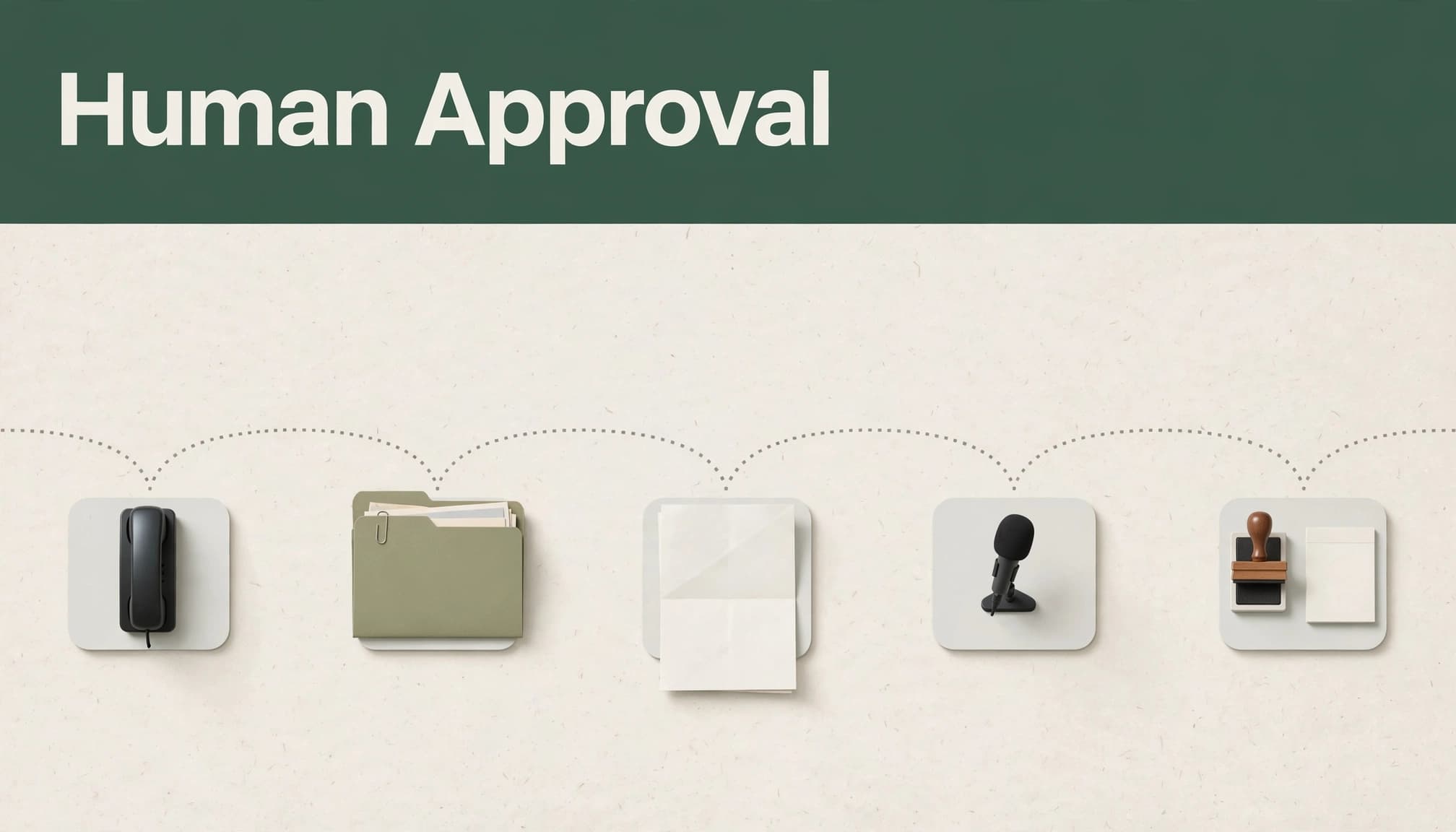
Every review role needs a named person and deputy. Communications owns clarity; the subject-matter lead owns technical accuracy; counsel owns legal review. The executive approver owns release.
The following schedule provides a 60-minute review budget.
Review role | Main responsibility | Time limit |
|---|---|---|
Agency lead | Message, audience, and channel | 10 minutes |
Quality manager | Facts and subject-matter clearance | 15 minutes |
Counsel | Legal duties and exposure | 20 minutes |
Managing director | Accountable release decision | 10 minutes |
Account manager | Approved-version distribution | 5 minutes |
These limits control routing, not evidence standards. An expired deadline triggers escalation to the deputy, never automatic approval.
For a data breach, counsel should assess statutory breach notification duties, admissions of fault, insurance-policy conflicts, and defamation risk. Counsel should also assess whether employees need a statement first. A public holding statement doesn't replace required notices.
Reviewers should work on one version with tracked changes. Any substantive revision after approval returns to the relevant reviewer, because a stylistic substitution can change legal meaning.
The final approver must have authority to delay or reject publication. The release record should preserve the evidence, material edits, reviewer identities, approval time, final version, and correction owner.
7. Apply the pre-publication checklist
The final pass should compare the approved statement with its evidence and distribution copy.
Match every name, date, figure, quotation, and affected group to a confirmed source.
Confirm that actions and commitments have authorized owners, resources, and realistic deadlines.
State harm plainly, preserve uncertainty, and remove robotic reassurance or promotional language.
Test audience fit, accessibility, instructions, contact routes, and update timing across channels.
Resolve legal, privacy, security, and employee-notification questions before distribution.
Record the human release decision and publish only the approved version.
An AI detector score cannot establish any of these findings. Approval depends on evidence and judgment, regardless of how human the writing sounds.
Frequently Asked Questions
Can AI publish a statement during a live crisis?
AI can organize approved information and generate draft language. A named human spokesperson must authorize release. Scheduled publishing and automated distribution should remain separate from that authorization.
Must every statement disclose AI-assisted drafting?
Disclosure should follow applicable obligations and the organization's policy. AI involvement in the incident itself requires clear explanation when material. Drafting assistance doesn't transfer responsibility: the spokesperson and approving leader still own the statement's claims.
The release decision remains human
A credible crisis statement connects public claims to evidence, operational action, and accountable ownership. Editing succeeds when it preserves those connections through every revision.
The final measure is whether the organization can substantiate what it says and deliver what it promises. Natural language helps people understand that record; human judgment determines whether the record is ready for public release.