An artificial intelligence tool or press release generator can craft polished AI-generated content that still fails the brand behind it. The facts may be accurate, the format may look familiar, and the language may be clean, yet the draft can read as if it came from any company in the category.
That is the central risk in public relations. AI press release editing treats output as a starting draft, not a finished release, needing a human editor who can restore the company's judgment, vocabulary, proof points, and restraint.
The strongest releases use AI to reduce blank-page work, then rely on human expertise to make each claim credible.
Even the most advanced press release generator can organize a draft quickly, but it cannot reliably reproduce a brand's judgment or institutional memory.
Editors should revise the message before polishing sentences, starting by aligning core key messages with the announcement's real news value.
Brand voice depends on word choice, proof, pacing, and what the release refuses to claim.
Every figure, attribution, customer reference, and executive quote needs human verification to maintain journalistic standards.
Legal and compliance review should occur before distribution, supporting broader media relations efforts rather than just internal approvals.
Generative tools powered by artificial intelligence are useful for turning source material into a workable structure. A prompt containing the announcement date, product details, spokesperson, approved facts, and audience can produce a serviceable first pass in minutes for public relations teams. PR Newswire, for example, describes AI tools as a way to speed drafting, optimization, and distribution in its overview of AI press release tools.
Speed, however, can conceal weak editorial decisions. A typical press release generator often fills missing context with broad claims, generic transitions, and language that sounds confident without saying much. Phrases such as "industry-leading," "revolutionary," and "unmatched" can appear even when the source materials provide no evidence for them.
A press release has a narrow job. It states what happened, why it matters, who can verify it, and where readers can learn more. An editor must protect that purpose from inflated language and unsupported inference.
The first pass should begin with a source packet, not a loose request to "write a release." Idea Grove's guidance on AI press release prompts makes the practical point: provide the who, what, when, where, and how. Missing details don't become true because a press release generator supplies plausible wording.
Before line editing, the editor should answer four questions to maintain journalistic standards and ensure a proper press release format for media outreach:
What is the actual announcement?
What evidence supports its importance?
Which target audience needs this information now?
What should the release avoid implying?
Those answers shape the headline, lead paragraph, quote, and boilerplate. Without them, the text becomes a collection of polished sentences with no clear news value.
A release can be grammatically sound and still be unusable if its claims exceed the approved facts.
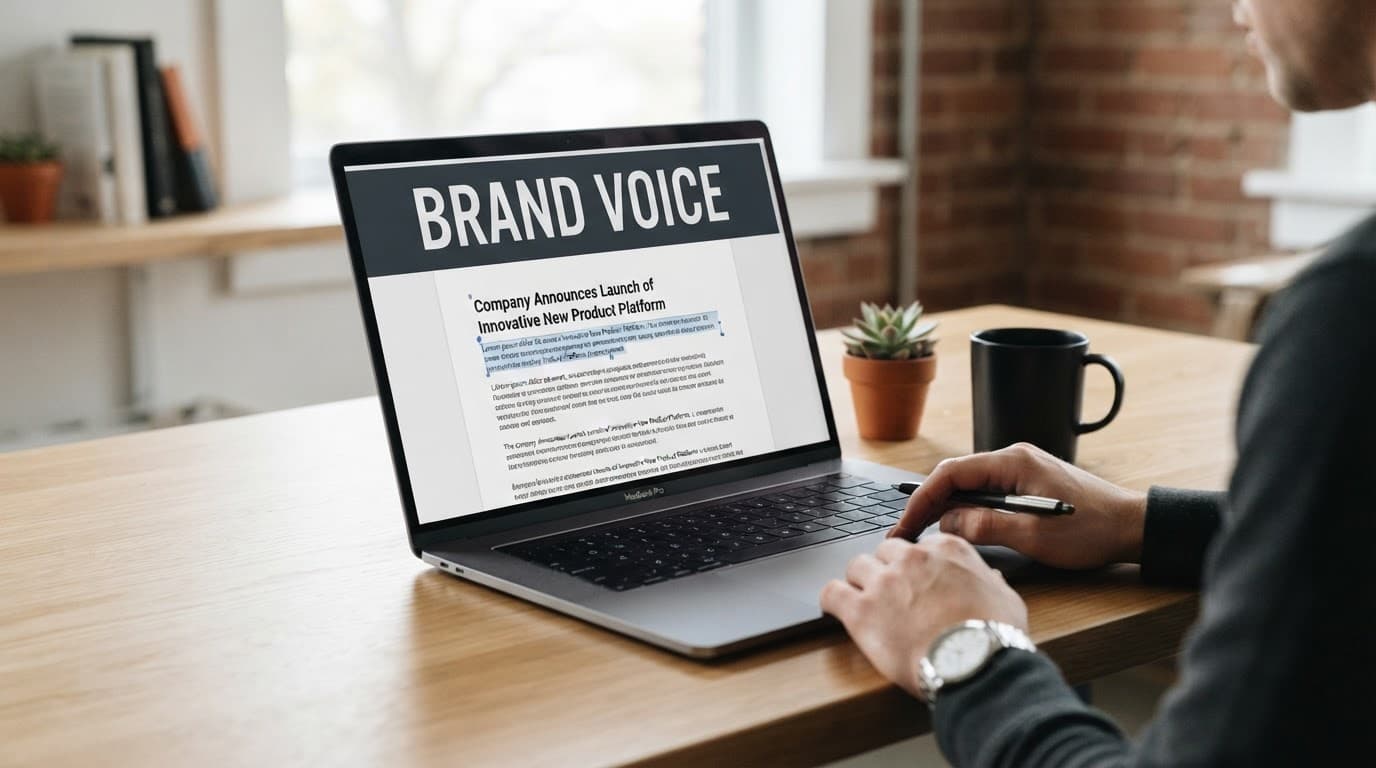
Brand voice is more than a preferred adjective list. It is the company's pattern of judgment. Some brands write with plain, technical precision. Others use an optimistic, conversational tone. A regulated financial firm may avoid casual promises, while a consumer brand may speak in short, energetic lines.
Automated content creation tends to average these distinctions by falling back on corporate jargon and familiar press release patterns. It recognizes standard phrases and reproduces them. That makes its drafts readable, but also interchangeable.
Editors can counter that tendency by maintaining a usable voice reference. The document should include approved messaging, banned claims, product names, capitalization rules, audience terms, preferred verbs, and several past releases that still sound current. A model can use those materials as input, but the editor should compare the draft against them sentence by sentence.
The comparison matters most in the headline and lead. Those lines set the tone journalists and stakeholders will carry into the rest of the release. If a brand usually reports measurable action, a vague headline about transforming the future breaks trust before the second paragraph.
A press release generator often produces predictable copy, but a few edits can change the character of a release without turning it into an advertisement by using straightforward storytelling techniques:
AI draft | Edited release copy |
|---|---|
"Acme is thrilled to announce its groundbreaking new platform, which will revolutionize team productivity." | "Acme launched a platform that helps operations teams assign, track, and document field work in one system." |
"The solution delivers unmatched results for customers everywhere." | "Early customers used the platform to replace separate scheduling and reporting tools." |
"This milestone reinforces Acme's commitment to innovation." | "The release expands Acme's field operations product line." |
The revised versions replace mood with information. They also leave room for readers to form their own conclusions.
For recurring AI press release editing, teams can build a short edit pass around common warning signs:
Remove praise that isn't tied to a verifiable outcome.
Replace abstract nouns with the product, service, customer group, or event being discussed.
Cut claims about leadership unless a credible ranking, award, or market measure supports them.
Keep product terminology consistent with approved naming.
Retain a small amount of brand personality, but don't force a campaign slogan into a news announcement.
Writers rely on a press release generator to speed up initial content creation, while a reliable press release template helps keep the structure sound. Using a dedicated press release template or a press release generator ensures the layout remains consistent during AI press release editing.
Writer's AI press release agent illustrates how AI systems can generate announcement drafts from a template. Templates help with order and completeness. They should not decide what counts as news or how strongly a company can state a claim.
The edit should move from substance to surface. Starting with commas and word swaps can make a weak release look finished before anyone has tested its assertions. When you rely on a press release generator, the initial output often buries the true value of product launches under generic fluff.
First, check the headline and opening paragraph against the source materials. Dates, locations, launch status, product availability, customer names, prices, research results, and performance figures need direct support. If an announcement says a service is available nationwide, the editor needs confirmation that it is available in every relevant market, not merely in several major cities. Protecting your core key messages requires rigorous fact-checking before public distribution.
Then examine comparisons. Statements such as "first," "largest," "only," and "leading" carry a high burden of proof. Unless the organization has reviewed evidence that supports them, they should be removed or narrowed. "Among the first" is not a safe substitute if no one can document it.
Quotes require the same discipline. AI can produce an executive quote that sounds fluent but was never spoken or approved. A spokesperson may sign off on a drafted quote, but the release should not present it as a spontaneous statement. The communications team needs confirmation that the named person accepts both the attribution and the substance.
Quote verification often improves the prose. When you combine human expertise with data-driven insights, you ensure that executive statements accurately reflect real company milestones. A concise, specific quote is far more believable.
Before: "We are incredibly excited to bring this transformative capability to market and empower organizations to achieve unprecedented success."
After: "Customers asked for a faster way to review field reports. This release gives managers that option without changing their existing workflows."
The second quote states a customer need and a concrete outcome. It also sounds like a person with responsibility for the product might say it.
Legal, regulatory, investor-relations, and compliance teams need defined review points, especially in enterprise communications where stakes are high. Their role isn't limited to risk language at the end of the release. They may need to assess product claims, forward-looking statements, endorsements, use of trademarks, disclosures, privacy implications, and timing restrictions to secure favorable media coverage.
A late legal review creates avoidable friction because it asks counsel to repair language after stakeholders have become attached to it. A better process gives reviewers the factual source packet and the draft's key messages early. Communications can then preserve the clarity needed to earn media coverage while addressing approved changes and protecting the integrity of all product launches.
A reliable workflow separates generation, editorial judgment, verification, and approval. Combining them in one hurried review invites mistakes because the same person may assume the draft's smoothness is evidence of accuracy.
The sequence can remain simple:
Prepare approved inputs.
Assemble the announcement brief, source documents, prior releases, messaging guidance, quotes, and disclosure requirements to support enterprise communications.
Generate a structural draft.
Use a press release generator or an established press release template as part of your broader communication strategy to organize confirmed information into a standard release format. Mark unknown details rather than allowing it to fill gaps.
Edit for news value and voice.
Rewrite the headline, lead, claims, and quote in the brand's natural register to effectively engage your target audience.
Run factual verification.
Confirm every proper noun, number, date, link, product claim, and attribution against a named source, ensuring the message serves public relations goals and strengthens media outreach.
Obtain stakeholder approval.
Route the release through communications, subject-matter owners, legal or compliance, and the quoted executive where needed.
Make a final distribution check.
Test links, contact details, standard press release format guidelines, search engine optimization factors for AI search engines, and regional spelling before publication, while evaluating the final draft using a press release score.
This order also creates a record of why a claim appears in the release. That record is useful when a journalist asks for evidence or a stakeholder questions an edit after distribution.
Teams should preserve an approved final version in a central library. Over time, that archive becomes stronger training material for enterprise communications than a generic prompt. It shows the organization how it describes its work when facts, legal review, and brand voice have all been resolved.
No, artificial intelligence can only generate a preliminary draft and organize information into a standard structure. Human editors are essential for verifying facts, checking claims, and ensuring the brand's unique voice and judgment remain intact.
You can avoid inflated language by providing a detailed source packet with approved facts instead of a loose prompt. An editor should actively replace vague adjectives and unsupported claims with concrete data and specific outcomes.
AI tools often produce polished sentences that conceal missing context, unsupported assertions, or unverified executive quotes. Verifying the substance first ensures the press release maintains journalistic standards and protects the brand's credibility.
A reliable workflow involves preparing approved inputs, generating a structural draft, editing for news value and brand voice, verifying all facts, and obtaining final stakeholder approvals. This step-by-step process prevents common errors and ensures a credible final announcement.
Artificial intelligence and any modern press release generator streamline routine content creation, especially for organizations that issue frequent announcements. Yet a press release does not gain authority because it avoids awkward phrasing. It gains authority when the language matches the evidence, supports media relations, and secures valuable media coverage for the organization behind it.
Effective AI press release editing treats raw AI-generated content as a starting point. Human reviewers supply the judgment that software cannot by applying advanced storytelling techniques, search engine optimization, and rigorous checks to maximize the press release score.
The final release should sound less like a machine's idea of corporate communication and more like a careful public record.