
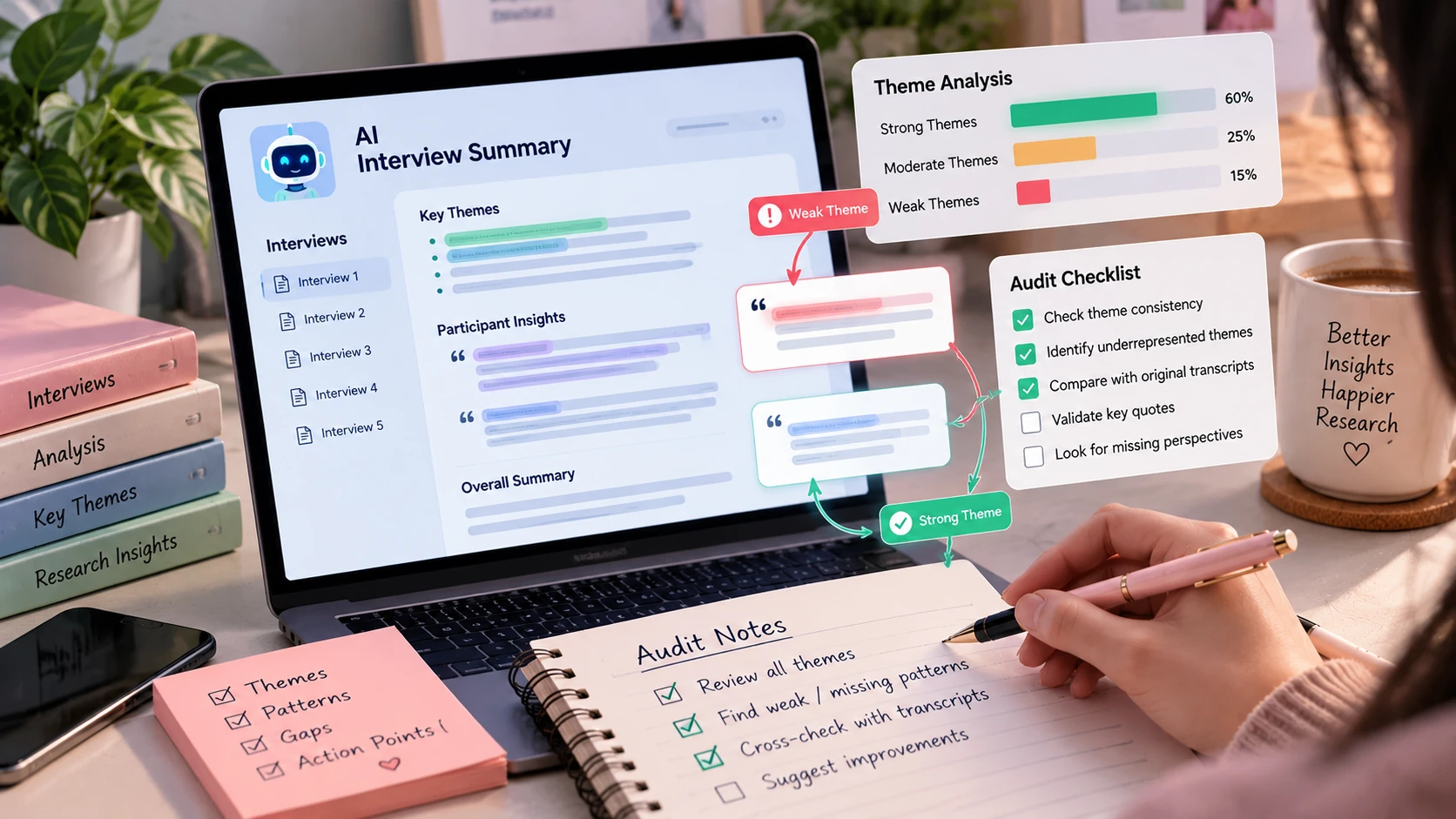
How to Audit AI-Summarized Interviews for Weak Themes
Text summarization can preserve every quoted sentence while AI summaries still reach an unsupported conclusion. In AI-summarized interviews, errors often arise between evidence and theme. A limited concern can become a shared preference, or a tentative explanation can become a cause.
AI-generated themes are hypotheses to verify, not findings to accept at face value. Review begins by separating what participants said from what the summary claims those statements mean.
The examples below use fictional interview excerpts to show the three corrections reviewers make most often: preserving speaker intent, replacing generic summaries with specific ones and removing themes that no participant raised. Each example pairs a before image with an after image.
Key Takeaways
Treat AI-generated themes as hypotheses to verify, not findings to accept at face value. Separate what participants said from what the summary claims their statements mean.
Trace each claim to checked source material, confirm the speaker and context, and record supporting, contradictory, and missing evidence. AI-provided citations are leads, not verification.
Assess coverage by participant and describe the sample's boundaries. Repeated excerpts from one person do not establish a shared customer view or population-level prevalence.
Narrow or remove claims that overstate scope, certainty, intent, or causation. Preserve uncertainty, exceptions, source references, and an audit trail in the final report.
Key terms used in this guide
Theme: an analytical claim that groups what several participants said.
Claim: one testable statement inside a theme, such as how many people said something or why it happens.
Coverage: which participants provide evidence for a claim, and which interviews gave them a chance to discuss it.
Speaker intent: what the participant meant to commit to, including hedges, conditions and refusals, not only the words in the excerpt.
What makes an interview theme unsupported?
An unsupported theme lacks adequate evidence for its meaning, scope, or certainty. It may contain a plausible interpretation while overstating how broadly that interpretation applies.
NIST's Generative AI Profile identifies confabulation as a risk of generative systems. For interview research, however, invented quotations are only one concern. Authentic excerpts can also support an inaccurate synthesis.
Separate observation from interpretation
A participant's account is evidence. A theme is an analytical claim about that evidence.
Researchers can interpret underlying needs without requiring participants to name them explicitly. However, the report should distinguish those interpretations from direct statements. A comment about a difficult task doesn't automatically establish the participant's motivation or preferred solution.
The audit should identify the reasoning that connects the excerpt to the theme. If that connection depends on an assumption, the assumption needs review.
Test the scope of the claim
Words such as "customers," "prefer," "need," and "because" carry different evidentiary demands.
A statement about a particular vendor's price cannot establish general resistance to a project. Likewise, interest in investigating an option doesn't establish an intention to adopt it.
A theme can therefore be partly supported but still require narrower wording. Deleting the whole observation would lose useful evidence; retaining the broader claim would misrepresent it.
A repeatable audit for AI-summarized interviews
The review needs a stable source packet: audio recordings where available, checked transcripts, interview guides, participant identifiers, and relevant session notes. Treat AI transcription as an aid, not a substitute for checking the source. Identifiers should protect confidentiality while allowing reviewers to trace evidence.
A practical audit follows four steps:
Preserve the original AI summaries, along with the prompt, model identifier where available, date, and source files.
Split each candidate summary into testable claims. A sentence about prevalence, dissatisfaction, and causation contains separate claims requiring separate evidence.
Locate supporting passages in the original transcripts. Record participant IDs, timestamps or line references, surrounding context, and contradictory passages.
Assign a decision to each claim: retain, narrow, remove, or hold for further investigation. Record the reason and reviewer.
The evidence record can live in a spreadsheet or research repository. MAXQDA's thematic analysis guide describes the broader analytical process; software organization doesn't replace checking the underlying passages.
Crucially, an AI-provided citation is a retrieval lead, not verification. The reviewer must open the passage and confirm its wording, speaker, and relevance.
The process should also include a source-first pass. Reading only excerpts selected by the model limits the audit to evidence the model already considered. Independent transcript review can reveal omitted concerns and patterns that never appeared in the summary.
Check evidence coverage without claiming representativeness
Coverage describes how evidence is distributed within the interview set. It doesn't establish how common a view is across the customer population.
Nowell and colleagues' work on trustworthiness in thematic analysis provides methodological grounding for making analytical decisions traceable. For an AI-summary audit, that means retaining the path between source material and interpretation.
Count participants, not quotation fragments
Several excerpts from one participant remain evidence from one participant. A long interview can otherwise dominate a summary simply because it supplies more text.
The audit should record which participants support a claim and which interviews offered a meaningful opportunity to discuss it. Those groups may differ. An interview that never covered pricing cannot establish either agreement or disagreement about pricing.
Repeated comments from the same customer organization also deserve attention. They may describe a shared operational setting rather than independent experiences across different customers.
Describe the sample's boundaries
Recruitment, customer tenure, role, and product exposure affect the claims a study can support. Research confined to experienced administrators cannot establish the needs of first-time users.
Counts can clarify coverage when the interview structure supports comparison. However, they shouldn't become population percentages without an appropriate sampling basis.
Matching quotes establish that a view exists in the material. They don't establish that it represents customers generally.
Frequency is also not the only measure of analytical importance. A less common account may reveal an important accessibility barrier or failure condition. Its limited coverage should remain explicit.
Restore context and search for counterexamples
A supporting excerpt needs enough surrounding material to establish what the participant meant. The preceding question can matter as much as the selected answer.
Verify attribution, conditions, and intent
Cross-talk, speaker changes, and poor audio can produce attribution errors. Before accepting a claim, reviewers should confirm that the customer said it, rather than the interviewer or another attendee.
The same discipline applies when reviewing AI meeting summaries: repeating an idea doesn't establish that someone originated or endorsed it.
Conditions also change meaning. A price objection tied to one quotation should remain tied to that quotation. A tentative account of improvement should retain its uncertainty.
Sentiment labels need similar scrutiny. Frustration with a particular workflow doesn't establish dissatisfaction with the entire product. Sarcasm, hesitation, and emphasis may require returning to the recording.
Example: preserve speaker intent
Speaker intent includes how firmly a participant spoke, not only what they said. Hedges such as "maybe" and "probably," conditions such as "if," and explicit refusals are part of the meaning. A summary that removes them can keep the topic accurate and still reverse the participant's position.
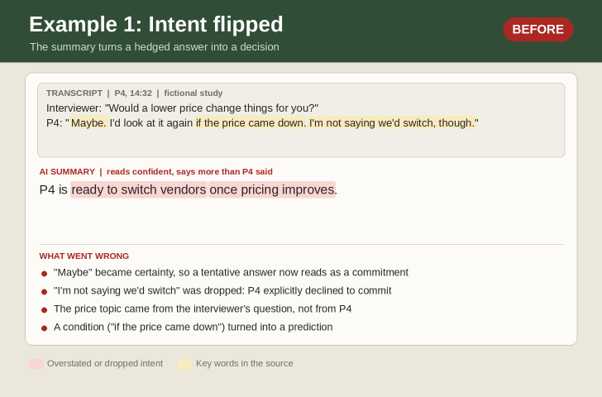
Before: the summary turns a hedged, conditional answer into a decision and drops P4's explicit refusal to commit.
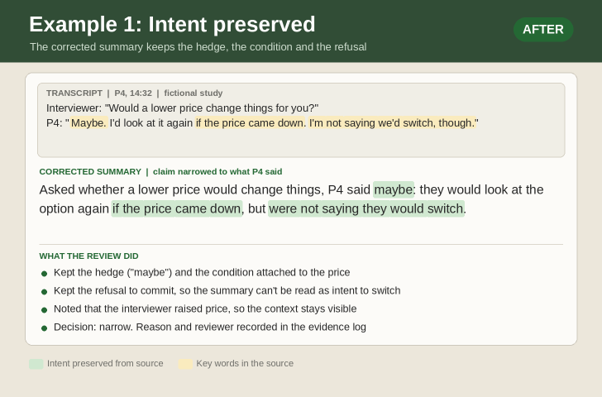
After: the corrected summary keeps the hedge, the condition and the refusal, and records the decision to narrow the claim.
Before approving any sentence about a participant's position, a reviewer can ask four questions:
Was the hedge kept? Words such as "maybe," "probably" and "I think" limit how far the claim can go.
Is each condition still attached to its trigger? "If the price came down" is not a prediction.
Who raised the topic? An answer to the interviewer's question differs from a concern the participant volunteered.
Did the speaker decline or qualify anything? A refusal belongs in the summary.
The corrected summary is longer and less elegant, which is acceptable. A shorter sentence that commits the participant to something they declined to say isn't a better summary. When a recording exists, check tone and emphasis there as well.
Examine evidence that challenges the theme
Reviewers should search the full interview set for disagreement, exceptions, and alternative explanations. Searching only for matching words encourages confirmation bias.
Counterexamples don't automatically invalidate a theme. They may reveal a boundary, such as a difference between occasional users and administrators. That boundary belongs in the finding.
Silence requires separate treatment. An unmentioned concern isn't evidence that a participant rejected it, particularly when the interviewer never raised the subject. The audit should distinguish explicit disagreement, absence of discussion, and an unclear response.
Example: avoid invented themes
An invented theme is a plausible-sounding claim that no participant actually raised. A model can assemble one from a single remark, a neighboring topic or familiar patterns in product research, then attach real quotations that seem to fit. The quotations are authentic, but the theme isn't grounded in them.
Before keeping any theme, a reviewer can ask:
Can I point to a participant who said this, or clearly described it, in their own words?
Would a neutral reader who saw only the quotations reach the same theme?
Does a counterexample or a silent interview change how the theme should be worded?
Is a need, wish or cause being inferred from a description of current behavior?
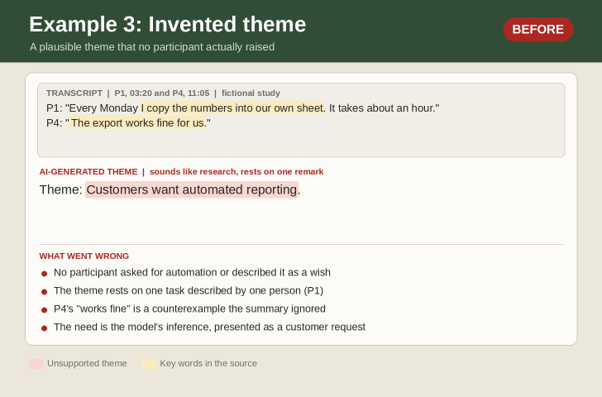
Before: the theme rests on one participant's manual task, and nobody asked for automation.
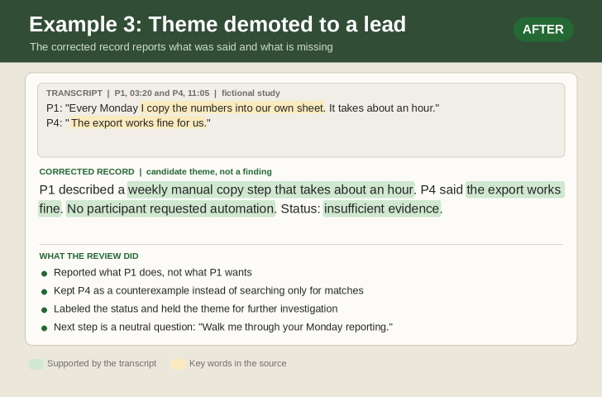
After: the theme becomes a candidate lead with a status label, a counterexample and a neutral next step.
The corrected record doesn't delete P1's remark. It keeps the observation as a lead and states what is missing. A neutral follow-up question, such as asking a participant to walk through their Monday reporting, investigates the task without asking anyone to endorse automation.
Common ways AI themes exceed their evidence
Overstatement often happens through small wording changes. A narrower observation becomes a preference, commitment, or causal explanation without new evidence.
These distinctions show where a summary needs correction.
Source evidence | Unsupported theme | More defensible interpretation |
A price concern relates to one vendor's quotation. | Customers reject the project as too expensive. | The account identifies a concern about that quotation. |
A participant tentatively credits a change with improvement. | The change caused better results. | The participant believes the change may have helped. |
Someone says they will investigate an option. | The customer has committed to adoption. | The customer expressed an intention to investigate. |
One participant repeats a concern across several passages. | Multiple customers share the concern. | Several passages document one participant's concern. |
Each correction preserves the observation while removing the unsupported extension.
Broad themes also require decomposition. A claim that a workflow is confusing, delays completion, and reduces trust contains several assertions. Evidence for confusion doesn't automatically support delay or loss of trust.
Example: correct a generic summary
Generic summaries read well because they are vague. "Users found onboarding confusing" could describe two people or twenty, and one step or the whole flow. The reviewer's task is to replace each vague word with something checkable: who, how many, which part.
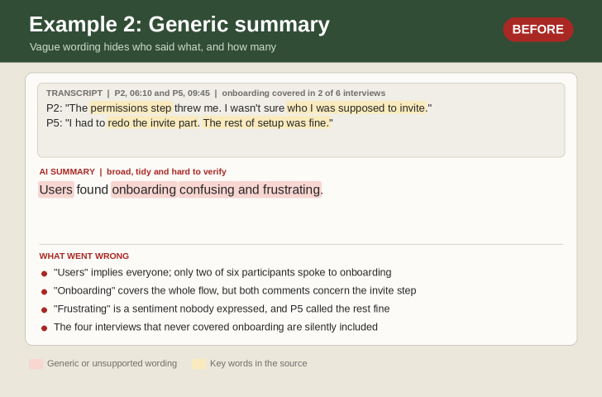
Before: "users," "onboarding" and "frustrating" are broader than anything the two participants said.
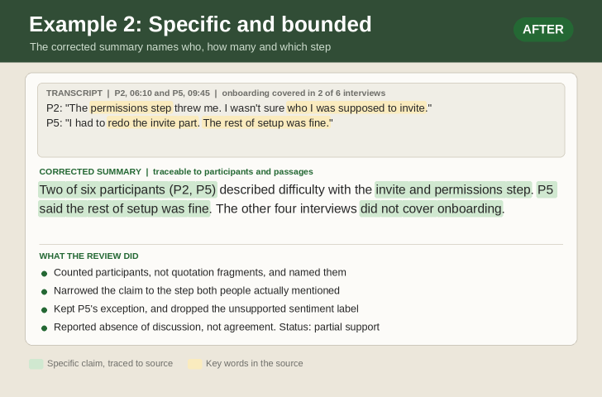
After: the corrected summary names who, how many and which step, keeps P5's exception and notes the silent interviews.
Four prompts help turn generic wording into a specific claim:
"Users" or "customers": which participants, out of how many?
"Onboarding" or "the workflow": which step or moment?
"Frustrating" or "confusing": did a participant say it, or is the label inferred?
"Often" or "many": counted how, and across which interviews?
Every addition in the corrected version can be checked against the transcripts: participant IDs, the count out of six, the specific step, the exception and the interviews that were silent. The generic sentence offers nothing to check.
These are meaning errors rather than grammar problems. Clearer wording helps only after the reviewer determines which claim the source supports.
Make uncertainty visible in the findings
Uncertainty can originate in the recording, the participant's account, or the researcher's interpretation. Those sources should remain distinct.
A missing audio segment is a source limitation. A participant's tentative recollection is uncertainty within the evidence. Competing explanations are an analytical limitation. Combining them under a generic confidence label hides what further investigation would resolve.
Use evidence-based status labels
A claim can have direct support, partial support, contradictory evidence, or insufficient evidence. Those labels should include a brief explanation and source references.
Model-generated confidence scores don't establish validity. A second generative AI or conversational AI system can't establish a theme's validity either. Agreement between models isn't evidence.
The record should state what remains unresolved, such as unclear attribution, limited segment coverage, or a missing account of the outcome.
Keep follow-up questions separate
Uncertain themes can guide subsequent interviews without appearing as established findings.
Follow-up should seek concrete sequences, actions, and consequences. Relevant records, such as support tickets or dated project documents, can help check an account when access and consent permit.
However, asking later participants to endorse the AI's wording risks introducing the conclusion into the evidence. Neutral questions should investigate the underlying experience rather than solicit agreement with a proposed theme.
Approve the evidence before polishing the report
The final report should preserve the audited finding, its scope, and material exceptions. Protect content accuracy during readability edits by preserving qualifiers, participant counts, causal wording, and source references.
Checks for meaning drift in AI rewrites apply here. Exact quotations should remain exact rather than becoming blended or reconstructed speech.
Teams should retain the original summary, evidence record, revised findings, and approval history. An audit trail for AI content makes later changes inspectable, particularly when findings move into presentations or product briefs.
A second researcher should challenge interpretations that could influence significant product decisions. Their role is to examine the evidence and alternative explanations. Agreement between reviewers alone doesn't prove a theme valid.
Review effort should reflect the consequences of error, consistent with the risk-management approach in the NIST AI Risk Management Framework. Claims concerning accessibility, safety, or costly roadmap commitments warrant closer scrutiny than routine descriptive notes.
Privacy practices remain part of that review. Customer identities, sensitive account details, and confidential recordings belong in approved systems with appropriate access and retention controls. Publication approval is separate from analytical validity: a supported finding may still contain material the team cannot share.
Frequently Asked Questions
Why can an AI interview summary be misleading even when its quotes are accurate?
Accurate excerpts can still be combined into a theme that overstates their meaning, scope, or certainty. A limited concern, for example, may be presented as a shared preference.
How should reviewers verify an AI-generated theme?
Split the theme into testable claims and trace each one to checked transcripts or recordings, confirming the speaker, context, and relevance. Search the full interview set for counterexamples and record the decision and its rationale.
Do repeated quotes show that a view is common among customers?
No. Several excerpts from one participant remain evidence from one participant, and interview findings do not establish population prevalence without an appropriate sampling basis. Report who supported the view and describe the sample's limits.
What should teams do with themes that have incomplete or conflicting evidence?
Label the status clearly, such as partial support, contradictory evidence, or insufficient evidence, and explain what remains unresolved. Such themes can guide neutral follow-up questions, but should not be presented as established findings.
What does preserving speaker intent mean in an AI summary?
It means keeping how firmly and under what conditions a participant spoke, including hedges, conditions, refusals and uncertainty. Without them, a summary can turn a tentative remark into a decision or a preference.
How can a reviewer tell a generic summary from a specific one?
A specific summary says who, how many, which part of the experience and what was actually said, and it notes interviews that didn't cover the topic. A generic summary relies on broad words such as "users" and "onboarding" that can't be checked against any passage.
What is an invented theme?
It is a theme that sounds plausible but that no participant raised, often built from a single remark or from a model's inference about what customers need. Check it by finding a participant who said or clearly described it, and by searching for counterexamples.
Conclusion: Findings need a traceable basis
The value of AI-summarized interviews depends on whether their themes survive scrutiny against the original accounts. A defensible finding preserves its supporting evidence, contextual limits, and unresolved contradictions.
The strongest review produces bounded claims, not stronger-sounding prose. Where the evidence remains incomplete, the report should preserve that incompleteness rather than turn a plausible hypothesis into a customer fact.