Fluent AI copy can make a stereotype sound like common sense. That is why AI content bias needs editorial review before publication, not a quick tone check after the draft is finished.
Generative AI bias is the broader concern when fluent outputs reproduce familiar stereotypes or cultural assumptions. Those patterns have ethical implications, so publication still requires human editorial review and judgment.
A strong review process checks what the draft says, what it leaves out, and whose perspective it treats as the default. It also supports bias mitigation by checking representation and inclusive language before readers see the work.
Treat AI-generated material as an unverified draft. Hallucinations can invent details, while automation bias can make fluent output seem authoritative.
Check text and images for stereotypes, omissions, assumptions about language or family, and uneven representation.
Use a repeatable bias mitigation process. Identify the stakes, compare outputs, check evidence, and locate input bias in prompts, system bias in models, or application bias during publishing.
Give human reviewers enough context, time, and authority to change or stop publication, while considering the ethical implications of each decision.
Rewriting can improve clarity, but it can't verify claims, restore a missing perspective, or establish cultural accuracy.
Bias isn't limited to abusive wording or a lack of inclusive language. A friendly campaign can still frame one group as a problem to solve, make another invisible, or reinforce stereotypes built around a narrow social norm. These choices have ethical implications for representation, trust, and access.
The NIST AI Risk Management Framework distinguishes systemic bias, computational and statistical bias, and human-cognitive bias. Machine learning bias, algorithmic bias, and generative AI bias overlap. They point to different lifecycle stages, including the model, data, prompt, and final use. System bias describes structural conditions, and bias can enter without an author's conscious intent. Assumptions can create cultural bias, selected examples can reflect confirmation bias, and evaluation choices can introduce measurement bias. That makes careful editorial review more important, not less.
Models learn patterns from training data. Historical exclusions in training data, unequal media attention, dominant-language preferences, and repeated identity-status associations shape those patterns. Diverse training datasets may reduce some gaps, but source variety doesn't guarantee accuracy.
Representation bias appears when models depict executives as men, caregivers as women, or affluent Western settings as professional norms. These patterns can reinforce gender bias and occupational bias. A second form of representation bias appears through absence, leaving smaller language communities with thin or inaccurate material.
Prompts, templates, preferred examples, and publishing incentives all influence a draft; application bias can amplify a model's defaults at publication. A request for "a typical family" or "professional appearance" can embed input bias before the model writes a word.
Explicit bias uses a slur or direct generalization. Implicit bias is harder to spot because it hides in defaults, tone, metaphor, and selection. A sentence that calls one accent "neutral" or one community "hard to reach" can imply a hierarchy without stating one. This review supports bias mitigation, but residual bias may remain, carrying ethical implications for readers and communities.
Reviewing bias means looking beyond grammar. A human bias review checklist should inspect patterns across a whole asset, including headlines, examples, image prompts, captions, calls to action, and metadata.
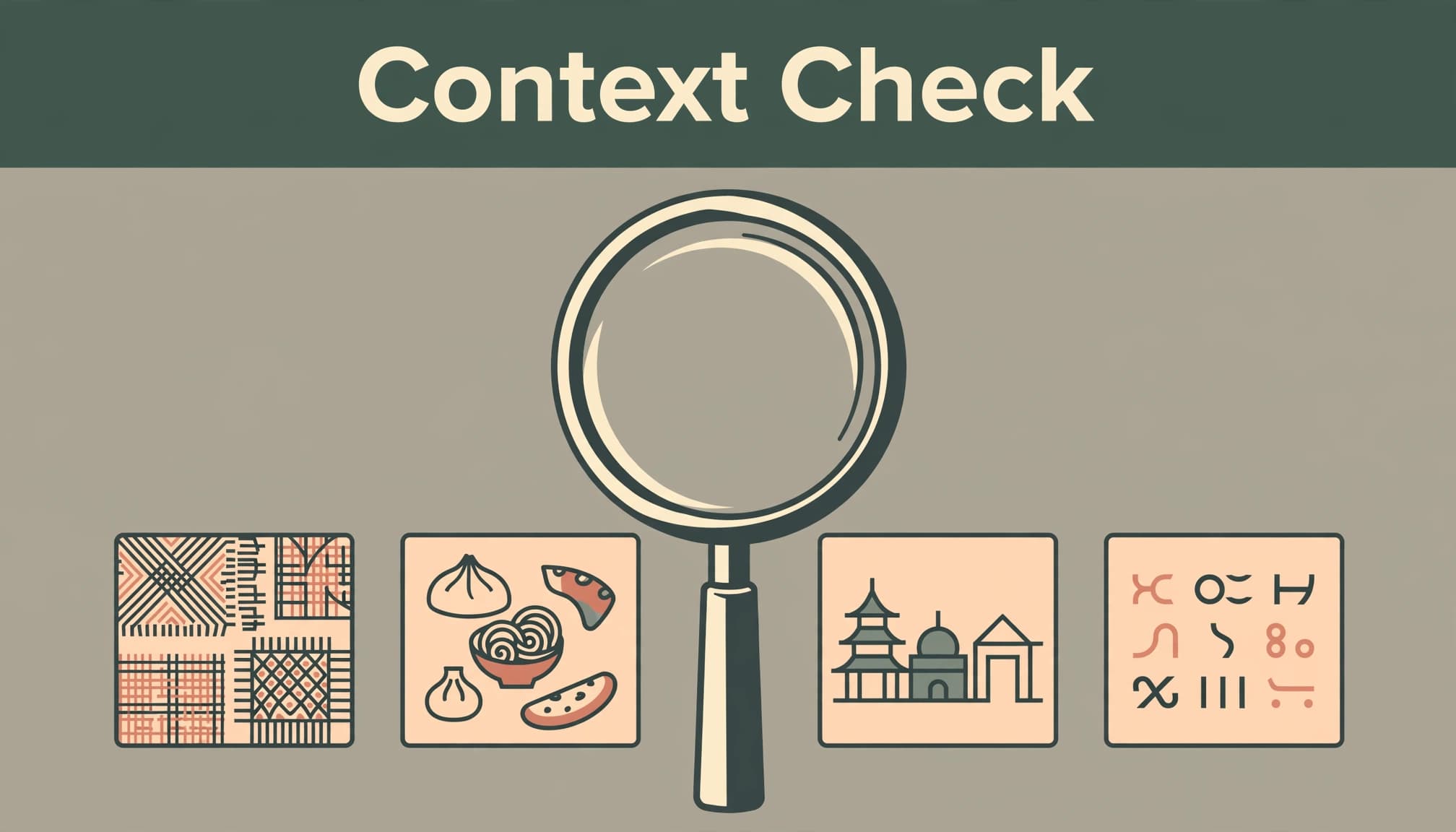
Editors should flag language that turns a diverse population into a single type, since identity assumptions have ethical implications. Phrases such as "their culture values" or "these people prefer" need evidence, scope, and often a rewrite. Communities contain different generations, regions, beliefs, incomes, and personal views. Watch for out-group homogeneity bias, the tendency to treat an outside group as more uniform than one's own.
The following questions expose common problems:
Who is visible, authoritative, or treated as ordinary, professional, safe, educated, or family-oriented? What representation bias appears in those choices?
Does the copy assign traits, jobs, spending habits, or risks to an identity group? Does it create gender bias or occupational bias around professions, leadership, caregiving, or authority?
Does it confuse nationality, ethnicity, race, religion, language, disability, or immigration status?
Are idioms, humor, names, and references understandable for the intended audience?
Could the same wording have different consequences through application bias in advertising, education, hiring, or public information?
Does the draft state a practice as universal when it only applies in a specific place or setting?
A local reviewer can improve accuracy, but that person should not be expected to speak for an entire culture.
Those ethical implications continue in visual work, where images can reinforce narrow assumptions. Text-to-image systems can repeat narrow role assumptions at scale. Review who appears in leadership, medical care, classrooms, customer scenes, and technical roles. Also inspect clothing, facial expressions, body type, age, disability representation, and setting.
A diverse-looking image is not automatically a fair one. Tokenism can place one visibly different person at the edge of a group while giving everyone else the action and authority. Editors should also avoid using cultural dress, food, or landmarks as shorthand for a whole population.
Alternative text needs the same care as inclusive language and visual representation. Human editorial review should check that alt text explains the image's purpose on the page, not inventory every visible object. Visual-only instructions, vague links, and captions that depend on color or position can exclude people using assistive technology. Together, these checks support practical bias mitigation, not a guarantee of neutrality.
A polished image can make an inaccurate social claim feel more credible than an awkward sentence does.
A long ethics review isn't necessary for every social post. However, a short scoring method helps teams triage machine learning bias and give high-impact content the scrutiny it needs. The score supports bias mitigation by weighing likely harm, reach, and ethical implications, but it isn't a definitive fairness verdict. Use it to separate input bias in prompts, system bias in model behavior, and application bias in downstream use.
Rate each category from 0 to 2. Score 0 means no apparent issue, 1 means the editor needs a revision or source check, and 2 means specialist review is required.
Review area | 0 | 1 | 2 |
|---|---|---|---|
Stereotype or exclusion | No concern found | Broad or unclear framing | Direct stereotype or harmful omission |
Audience impact | General, low-stakes use | Public campaign or classroom use | Employment, health, legal, safety, or crisis content |
Evidence and context | Approved current sources; training data documented | Some claims need support | Material claims lack a traceable source |
Representation bias | Purposeful and relevant | Limited range of examples | Repeatedly narrow or demeaning portrayal |
A total of 0 to 2 can move through normal editorial review. A score of 3 to 5 needs revision and a second editor. Work-related content deserves an occupational bias check, especially when hiring or professional authority is involved. A score of 6 to 8 should pause publication until a subject-matter, localization, legal, or DEI reviewer assesses it.
Run the same request with meaningful variations instead of trusting one polished output. This helps counter confirmation bias and creates a simple form of adversarial testing.
Change names, pronouns, locations, age, disability status, family structures, and language varieties where relevant. Then compare who receives authority, sympathy, expertise, blame, or visibility.
Quantitative fairness metrics can add evidence. Statistical parity and counterfactual fairness are different analytical lenses, not universal proof of fairness.
These comparisons don't prove a model is fair. They reveal unstable patterns and residual bias that may remain after revision, even when a single output looks polished. Use the findings to guide bias mitigation, while considering their ethical implications in context rather than replacing editorial judgment. NIST's Generative AI Profile recommends computational testing, structured feedback, subgroup testing, and documentation when evaluating bias and stereotypes.
Cultural review works best when editors start with the assignment, not with a generic inclusivity checklist. A museum label, a public-health notice, a student lesson, and a global product campaign carry different cultural bias risks. An underspecified assignment can also introduce input bias before drafting begins.
Editors should identify the audience, the people described, and those who may act on the content. These choices have ethical implications when language can affect access, treatment, or opportunity.
A fictional travel article may need careful regional detail. A hiring, health, housing, or law-enforcement communication needs a higher threshold. System bias can reflect institutional constraints, while application bias can arise from the setting where copy is used.
The Federal Trade Commission has warned that AI tools may be inaccurate, biased, and discriminatory. Its report on AI risks is a reminder that polished output doesn't reduce the need for human editorial review of inclusive language, accessibility, and representation.
AI drafts often omit preconditions, trade-offs, uncertainty, and recovery steps. Checking those gaps is a practical form of bias mitigation. Editors should ask whether a recommendation assumes reliable internet access, a particular household structure, familiarity with bureaucracy, or a standard work schedule.
Retrieval-augmented generation can ground a draft in selected context, but it doesn't replace accountable review.
The same test applies to accessibility, where ethical implications can affect access and opportunity. Does a call to action explain the destination? Are headings in logical order? Does a form instruction describe an error without relying on color? Content only works when its structure and language work in the actual interface.
For sentence-level revisions and proofing habits, the site's practical writing improvement techniques offer useful editing routines. Cultural and factual judgments, however, still require accountable human review.
Retrieval-augmented generation, often called RAG, connects a model to a selected source set, distinct from its broader training data. For a content team, that might include approved policy documents, current product records, expert interviews, and localized style guidance.
Retrieval-augmented generation improves traceability, but it doesn't establish truth or cultural completeness. A system can still choose a poor source, quote it out of context, or make an unsupported inference, creating hallucinations. Narrow source collections can also leave residual bias and limit cultural representation.
Editors should check the source behind each consequential claim, date, quotation, statistic, and link. Assess source quality and its ethical implications, ensuring the source supports the exact wording, not merely the broad topic.
Retrieval can't correct input bias in a prompt or system bias in the model or workflow. It also can't resolve application bias in an inappropriate publishing context. Use it as one bias mitigation control, with human editorial review for remaining risks.
The publication record should include the draft's purpose, tool and model where available, source list, material edits, reviewer names, approval date, and any escalation decision. This accountable documentation supports source traceability and transparent AI use, helping reviewers inspect the basis for consequential claims.
For sensitive content, retain prompt summaries rather than copying personal or confidential data into a broad workspace. Consider the ethical implications of retention, access, and reuse.
UNESCO's guidance for generative AI calls for safeguards against discriminatory and false content while protecting linguistic and cultural diversity. That standard requires ongoing review, especially when content changes audiences or countries.
AI governance is useful only when it gives people clear responsibilities. It should treat algorithmic bias as a lifecycle responsibility, with transparent decision records at each review stage. A policy that says "use AI responsibly" leaves editors to improvise when deadlines tighten.
The communications lead can assess audience fit, tone, stereotypes, and representation through human editorial review. A fact-checker can verify claims. Localization, accessibility, legal, security, or subject-matter reviewers should enter when needed.
They can check input bias, system bias, or application bias before approval. Teams should document source-connected workflows, including retrieval-augmented generation, along with their ethical implications.
High-risk triggers should include regulated advice, content about protected groups, personalized messaging, crisis communications, synthetic images of real people, and material based on sensitive data. Triggers should also include adversarial testing failures, system bias in the workflow, or likely harm to brand reputation.
The final approver must have authority to delay or reject the asset. Human oversight should document ethical implications, required bias mitigation, and correction steps in transparent decision records.
AI detectors and similarity tools can flag material for further review. They can surface possible hallucinations, but they can't establish authorship, cultural accuracy, permission to use an image, factual reliability, or suitability for publication.
Likewise, a humanized rewrite may remove repetitive phrasing while preserving the same false assumption. Automation bias can make reviewers accept detector scores or polished rewrites without examining meaning. The review sequence should assess meaning before polish, then recheck that edits didn't weaken evidence, alter a quote, or erase a limitation.
Before publication, the responsible editor should use this bias review checklist. It supports bias mitigation across stereotypes, tokenism, inclusive language, accessibility, representation, and human editorial review. Confirm the following:
The draft has a named owner who approves the final version, and the workflow has safeguards against system bias.
Every material fact, quotation, date, statistic, and link has a current, traceable source.
The content avoids broad claims about cultures, identities, languages, or communities.
Text and images were checked for stereotypes, tokenism, coded assumptions, missing perspectives, and representation bias.
Examples fit the actual audience. They don't use occupational bias to assign roles or authority, or present one group as a default.
Headings, links, alternative text, captions, and instructions work for people using assistive technologies.
The team removed confidential, personal, or restricted data from prompts and records, and checked for input bias.
A second reviewer examined high-risk content and any asset with a high triage score or serious ethical implications.
The organization has a correction path if readers identify harm, inaccuracy, or ethical implications caused by application bias in the audience or use case.
Statistical parity can identify numerical imbalances, but it isn't a substitute for contextual or cultural review.
No. It can flag phrases, suggest alternatives, or compare outputs, but system bias may shape what it flags or misses. It can't independently account for community context or institutional conditions, so human review is still needed.
No. Inclusive wording can coexist with poor evidence, tokenistic images, missing perspectives, inaccessible design, or harmful framing. Editors need to inspect the full message, its ethical implications, representation, and likely use.
No. Review should match the level of risk. A low-stakes internal outline needs less scrutiny than a health campaign, hiring message, legal explanation, or public statement about a community.
AI-generated content can broaden an editorial workload as quickly as it speeds up drafting. Human judgment remains the control that tests evidence, context, representation, and the ethical implications of publication. That includes reviewing AI content bias before polished copy reaches readers.
The strongest process treats fluency as a starting point. It tracks input bias in prompts and source selection, system bias in model and workflow conditions, and application bias in publication and use. Ongoing bias mitigation depends on human editorial review, careful attention to representation, and responsible correction.