A rewrite can make a page read better while quietly weakening the signals that brought it search traffic. To preserve SEO keywords, editors must retain the page's meaning, intent, entities, structure, and useful routes through the site, not merely repeat the same phrase more often.
AI can tighten prose and remove repetition. It can also replace precise target keywords with broader terms, flatten a comparison, or drop a linked resource. It may recast an informational page as sales copy, weakening search engine optimization signals and drifting from a documented keyword strategy. A controlled process helps preserve SEO keywords by keeping those changes visible before publication.
Preserve the query's
search intent
before protecting individual words. Natural wording can vary while keeping the page's core job intact.
Build an inventory through keyword research: primary terms, supporting concepts, important entities, headings, claims, site links, and metadata.
Give AI a bounded assignment, such as rewriting one section for clarity within a defined keyword strategy, rather than requesting an uncontrolled rewrite.
Review factual claims, dates, quotes, citations, comparisons, and technical details manually. AI output is an editable draft, not verified reporting.
Track the revised URL in Search Console, then monitor search queries and search engine rankings after enough data accumulates.
Keyword similarity can hide a damaged page. A rewrite succeeds only when the revised page still answers the same search need with accurate, readable information.
A search-performing article contains more than sentences. Its title, headings, examples, entity references, image alt text, URL, and page structure support search engine optimization and search engine rankings.
Changing everything at once makes later diagnosis difficult. If clicks fall, an editor can't tell whether the problem came from altered intent, lost coverage, a broken link, stale facts, or normal search volatility. Content strategy and search engine algorithms both depend on these connected signals.
AI often substitutes near-synonyms that aren't truly equivalent in a search context. "Keyword difficulty" may become "competition," while "organic search traffic" becomes "website visitors." A page built around long-tail keywords can attract a different audience than one targeting short-tail keywords.
Those differences affect search volume and traffic potential. A keyword research workflow may use seed keywords, competitor analysis, and sources such as Google Keyword Planner, but each term still needs editorial review.
The same risk applies to qualifiers. A page about "free keyword research tools" does not mean the same thing as a page about "affordable SEO tools." Pricing, availability, product specifications, dates, quoted statements, and comparison language need close review because a single changed word can alter which search engine results pages the page reaches.
A keyword is part of a larger promise. Search intent shapes the keyword strategy and the content strategy. Searchers looking for "how to keep important SEO terms during AI rewrites" expect a practical editorial workflow. They don't need an introductory guide to every aspect of keyword research.
Google's SEO Starter Guide emphasizes useful page elements such as descriptive titles, relevant anchor text, images, and logical site organization. Those signals work together. Repeating an exact-match term in every paragraph, or relying on keyword stuffing, won't repair a rewrite that removed the steps, evidence, or context behind it. A durable keyword strategy supports meaning rather than repetition, helping search engine algorithms understand the page.
The first document in the process should be the existing page, saved in full. Include the rendered copy and source details where possible. Record keyword research sources before content optimization begins.
An editor who starts with pasted body text may miss links, captions, callouts, and structured elements that matter after publication. A clear keyword strategy keeps those details connected to the page's purpose.
Create a compact inventory before the rewrite begins. It doesn't need a complex platform or an enterprise subscription.
Element | Record before rewriting | Review after rewriting |
|---|---|---|
Primary query | Main target phrase and reader purpose | Meaning remains intact |
Supporting terms | Target keywords, related concepts, and task-specific phrases | Coverage remains natural |
Keyword types | Seed keywords, short-tail keywords, and long-tail keywords | Terms fit the page's focus |
Keyword metrics | Search volume, keyword difficulty, and traffic potential | Metrics remain tied to the same topic |
Research sources | Notes from Google Keyword Planner and other sources | Sources and assumptions remain clear |
Entities | Brands, tools, people, products, standards | Names and relationships stay accurate |
Headings | H1, H2s, and key H3s | Topic hierarchy remains clear |
Links | Anchor text, destination, and role, including internal links | URLs work and context fits |
Metadata | Meta description and title metadata | Page details still match the content |
Technical elements | Technical SEO details and structured components | Important elements remain functional |
Claims | Data, dates, comparisons, and sources | Facts remain supported |
Duplication risks | Sections that could introduce duplicate content | Repeated material is removed or justified |
The inventory separates what must remain accurate from wording that can change. It also supports a consistent keyword strategy without treating every repeated term as equally important.
Review the search engine results pages for the target query before revising. This helps clarify search intent and keeps the rewrite aligned with the existing content strategy.
A page can lose relevance when AI adds material for an adjacent but different audience. Competitor analysis may reveal useful gaps, but it shouldn't redirect the page toward a new topic.
For example, an editor may ask for more detail on SEO tools, then receive a product comparison that overwhelms a workflow-focused article. Long-tail keywords can help retain useful specificity because they often describe a clear task.
Search queries should support the page's purpose, not replace it. A sound keyword strategy considers traffic potential alongside relevance, while popularity alone doesn't override intent.
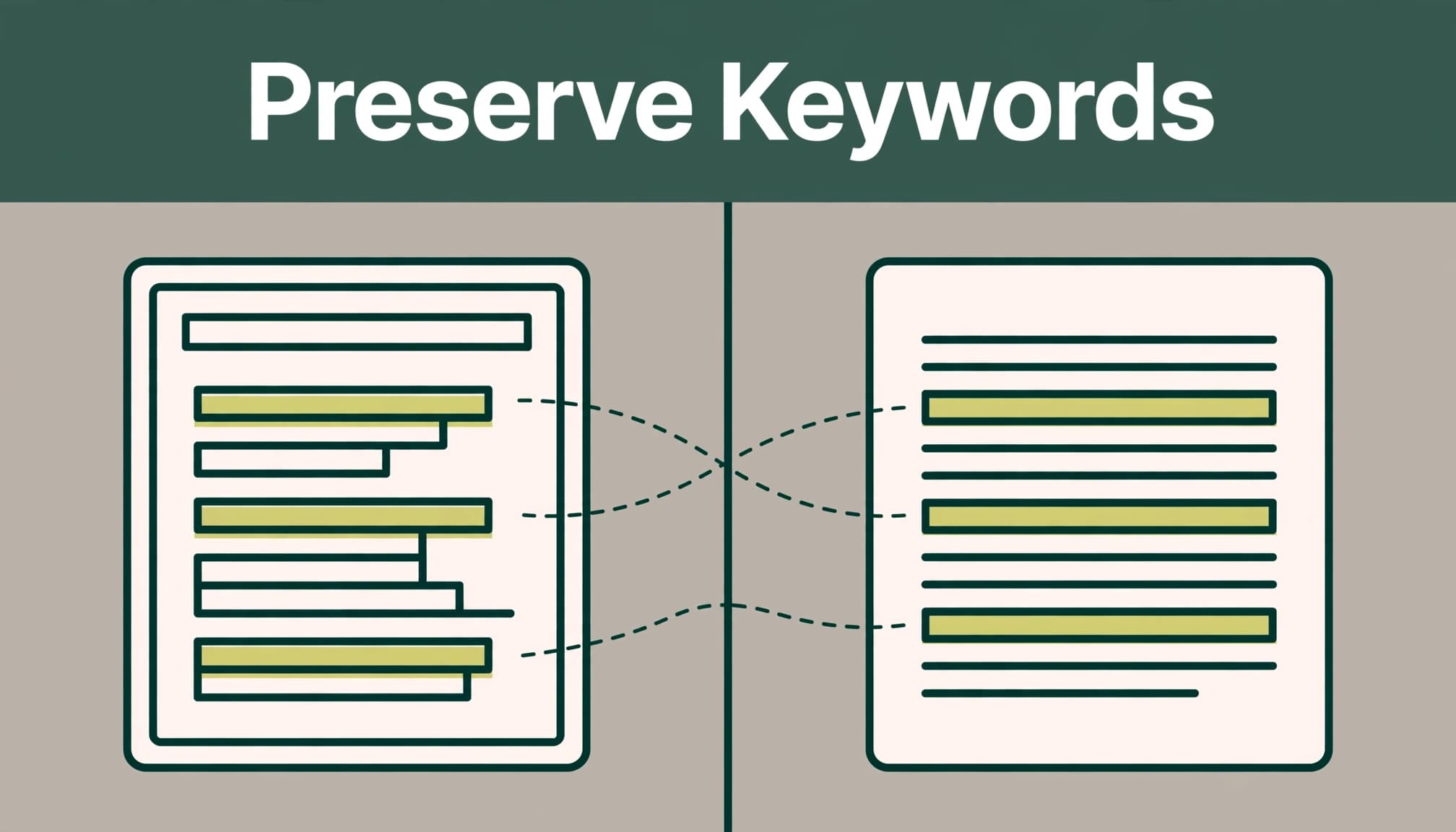
The goal isn't to make the new draft look mechanically identical to the old one. It's to keep the editorial and technical signals that explain why the page earned visibility, while improving clarity through focused content optimization.
A prompt should state the target query, audience, search intent, approved sources, protected entities, and sections that require care. It should also identify claims that can't be changed without verification.
Include keyword research findings when they shape the brief, such as relevant long-tail keywords and keyword difficulty. The keyword strategy should also define which claims, terms, and variations need protection.
Use current search engine rankings and traffic potential to decide whether to rewrite one section or the entire page. A narrower scope reduces the risk of changing signals that already support performance.
A useful assignment might request a 250-word section rewrite that retains the headings, references to Google Search Console, and all factual qualifications. It should prohibit new statistics, product claims, quotations, URLs, or citations. This limits the model's ability to invent plausible but unsupported details.
For larger articles, work section by section. Save each version and document how each change affects the keyword strategy. A visible record of material changes makes approval decisions less subjective and makes future performance analysis possible.
Internal links are part of the page's infrastructure. AI may omit them, alter a destination, or write anchor text that no longer matches the destination. Keep approved href values outside the rewrite prompt when possible, then restore the links manually after editing surrounding text.
This page-level linking work differs from broader link building, which concerns references from other websites. Anchor text may change if the sentence changes, but it must still describe the linked page honestly. A relevant internal resource on tips for clearer and more engaging writing can support an editing discussion. It shouldn't be inserted merely to carry an unrelated phrase.
Headings, tables, captions, product descriptions, FAQ answers, and quotations need separate review. Rewriters usually handle ordinary paragraphs better than compressed formats, where a small wording change can carry most of the meaning.
The sample below preserves the named tool, its function, and the page's factual scope while making the sentence more direct.
Original wording | Revised wording | What remains protected |
|---|---|---|
Google Search Console's Performance report shows queries, pages, and Average position. | The Performance report in Google Search Console shows the queries and pages driving visibility, along with Average position. | Google Search Console, Performance report, queries, pages, and Average position |
The revision doesn't need repeated exact-match phrasing. It keeps the entities and the claim intact, supporting the page's keyword strategy while improving flow. If an AI rewrite changed "Average position" to "rankings," the editor should restore the official metric because the terms are related but not interchangeable.
Natural language is useful only when it remains accurate. The final pass should read as if it were a new publication, with special attention to claims that sound polished enough to escape scrutiny.
Google's guidance on helpful, reliable, people-first content applies regardless of how a draft began. AI assistance does not excuse misleading claims, thin additions, or unsupported advice.
Verify each statistic against its primary source. Use keyword research to confirm that important terms match the subject and the supporting evidence. Confirm dates, product availability, pricing, quotations, company names, legal terms, and comparative claims. If the source is gone or outdated, remove the claim or replace it with current evidence.
Named entities need the same care. A rewrite can confuse two similarly named products, misstate who published a study, or turn a conditional recommendation into a universal one. It can also create duplicate content by repeating existing wording too closely, even when the facts are correct. These errors damage reader trust before they affect a ranking report.
Exact-match repetition is often the first sign of keyword stuffing. Read the revised copy aloud, then remove any keyword that makes a sentence sound forced without adding precision. Let editorial judgment control the final wording, rather than treating keyword strategy as a rigid rule.
Tools and methods for humanizing AI-generated text can help identify repetitive structures or stiff transitions. They cannot validate facts, intent, permissions, originality, or search quality. Search engine algorithms don't treat an AI-detection score as a ranking signal.
Before publishing, compare the old and revised pages side by side. The review should cover the rendered page, not only the document draft.
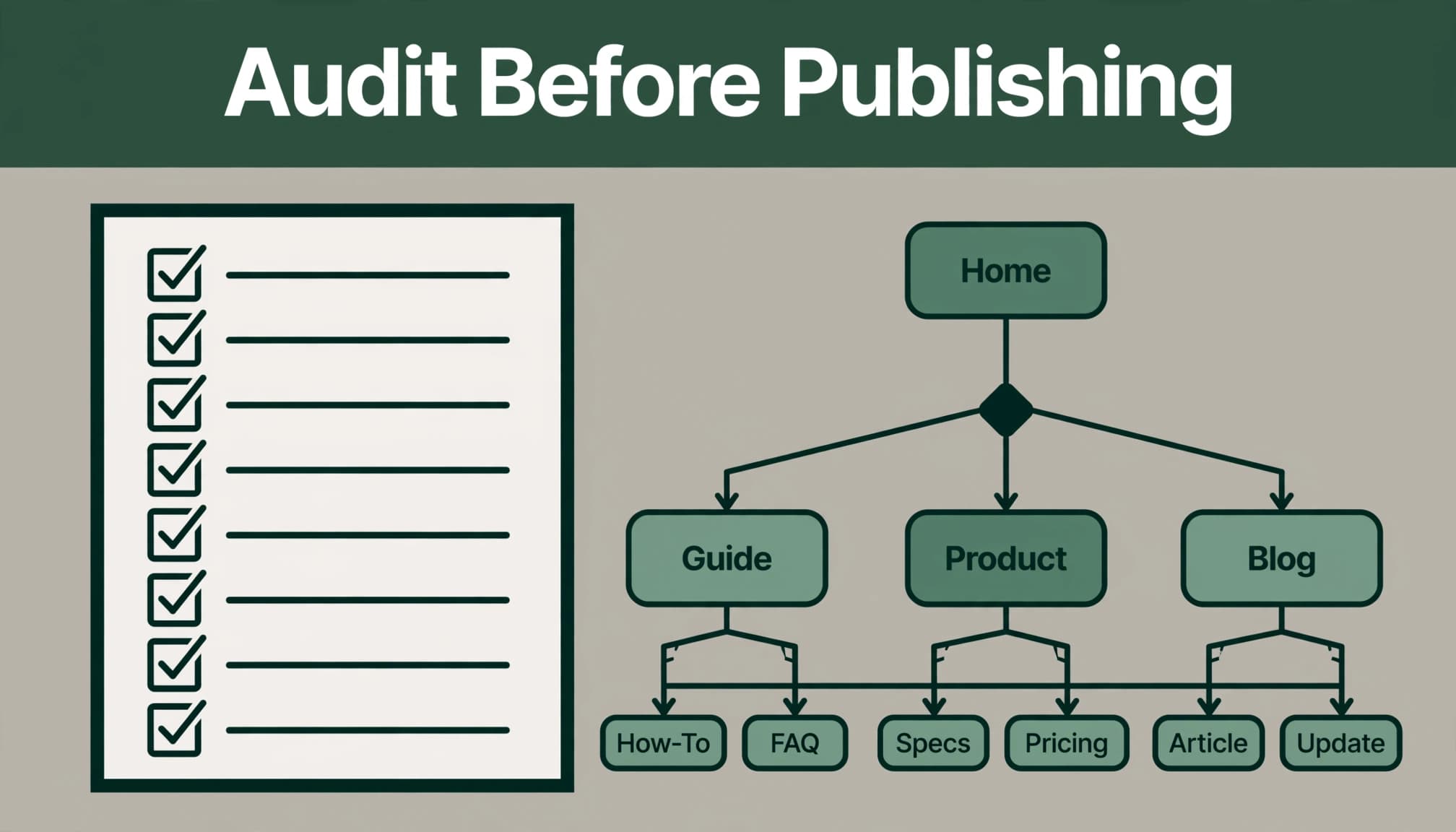
Confirm keyword research supports the primary query's fit with the page's search intent. Check that supporting terms, including long-tail keywords, appear where they add meaning.
Compare H1, H2, and H3 headings for lost topics, misleading promises, accidental duplication, or gaps in the keyword strategy.
Test all internal links, anchor phrases, final destinations, redirects, linked images, related-content modules, and calls to action.
Verify title metadata, meta description, canonical tags, indexation directives, schema markup, visible dates, and sitemap details when they apply. Check technical SEO elements that support search engine optimization.
Check facts, citations, entity names, quotations, numbers, availability statements, and comparisons against reliable sources. Flag duplicate content risks where relevant.
Inspect the published or staging URL on desktop and mobile, because templates can alter links and rendered content after the copy is approved.
A score can help teams make approval decisions consistent by applying the keyword strategy to traffic potential, content optimization goals, and accuracy. Assign a point to each protected element that remains accurate, then deduct points for invented claims, missing links, altered intent, duplicate content, or unsupported comparisons. Pages that fall below a defined threshold should return to editing rather than move into publication.
A content refresh needs a baseline, so record clicks, impressions, click-through rate, and Average position for the URL before publishing. Note search volume, keyword difficulty, and traffic potential across the search engine results pages, using the page's keyword strategy as context. Search Console's Performance report supports comparisons by page, query, country, and date range.
Some changes appear quickly, while others take weeks or months. Google says recrawling itself can take days to weeks, and broader SEO effects may take longer. A single day of data cannot explain whether a rewrite helped or harmed a page.
Traffic shifts also have several causes. Seasonality, news events, competitors, search-result changes, technical errors, and algorithm updates can move performance independently of the rewritten copy.
Compare equivalent periods, then review search queries, including long-tail keywords, and page reports. A drop in organic search traffic across many pages may point to broader demand or visibility changes, not necessarily a weak rewrite. A decline limited to one URL calls for closer inspection of the page's original purpose, coverage, and indexing. Review its content strategy and keyword strategy, then use competitor analysis to assess traffic potential and search engine rankings.
Google's guidance on debugging Search traffic drops recommends using Search Console data and Google Trends to investigate changes. During a core update, Google advises waiting at least one full week after the update finishes before analyzing its effect. A move from position 2 to 4 does not automatically justify a wholesale rewrite.
Yes. Rankings aren't permanent because search behavior, competing pages, source information, and Google's systems change. Ongoing work should include keyword research, accurate updates, useful coverage, sound technical SEO, and monitoring rather than constant rewriting.
There is no fixed timeline. Google may recrawl a page within days or weeks, while search performance can take longer to settle. The scale of the edit, the page's crawl frequency, and the competitive query all affect timing.
No. AI can retain phrases while changing their meaning through altered qualifiers, missing context, incorrect facts, or mismatched links. An uncontrolled rewrite can also create duplicate content. Editors must review the finished page for accuracy, readability, keyword strategy, and whether it still satisfies the original search intent.
To preserve SEO keywords, use search engine optimization that protects search intent and what target keywords must accomplish. A durable keyword strategy retains accurate entities, useful topic coverage, clear headings, and relevant internal paths while helping protect search engine rankings and improve readability.
The strongest revision is rarely the one with the most repeated phrases. It’s the page that remains accurate, useful, and recognizably aligned with the searcher's original need after every sentence has changed. That keyword strategy keeps the page focused without forcing repetition.