A resume bullet can sound polished and still tell a recruiter almost nothing. AI often produces tidy phrases about driving results, collaborating across teams, and improving processes, yet those phrases could describe thousands of applicants.
To humanize AI resume bullets, job seekers need to replace broad language with a truthful record of what they did, where they did it, and what changed afterward. AI can speed up a first draft, but the final wording must come from the candidate's own experience.
The strongest bullets read like compressed evidence, not corporate slogans.
Treat AI output as scaffolding. It can organize experience, but it can't verify scope, dates, metrics, or software skills.
Pull terms from the job description, then use each term only where it truthfully fits.
Build each bullet around an action, context, tool or method, and result.
Use brackets for missing facts rather than letting an AI tool invent a number or responsibility.
Read the finished resume aloud. Repeated rhythms and inflated language often sound wrong when spoken.
AI-generated resumes tend to rely on familiar sentence patterns because the model predicts language that has appeared in countless professional documents. The result may be grammatically sound while still feeling interchangeable.
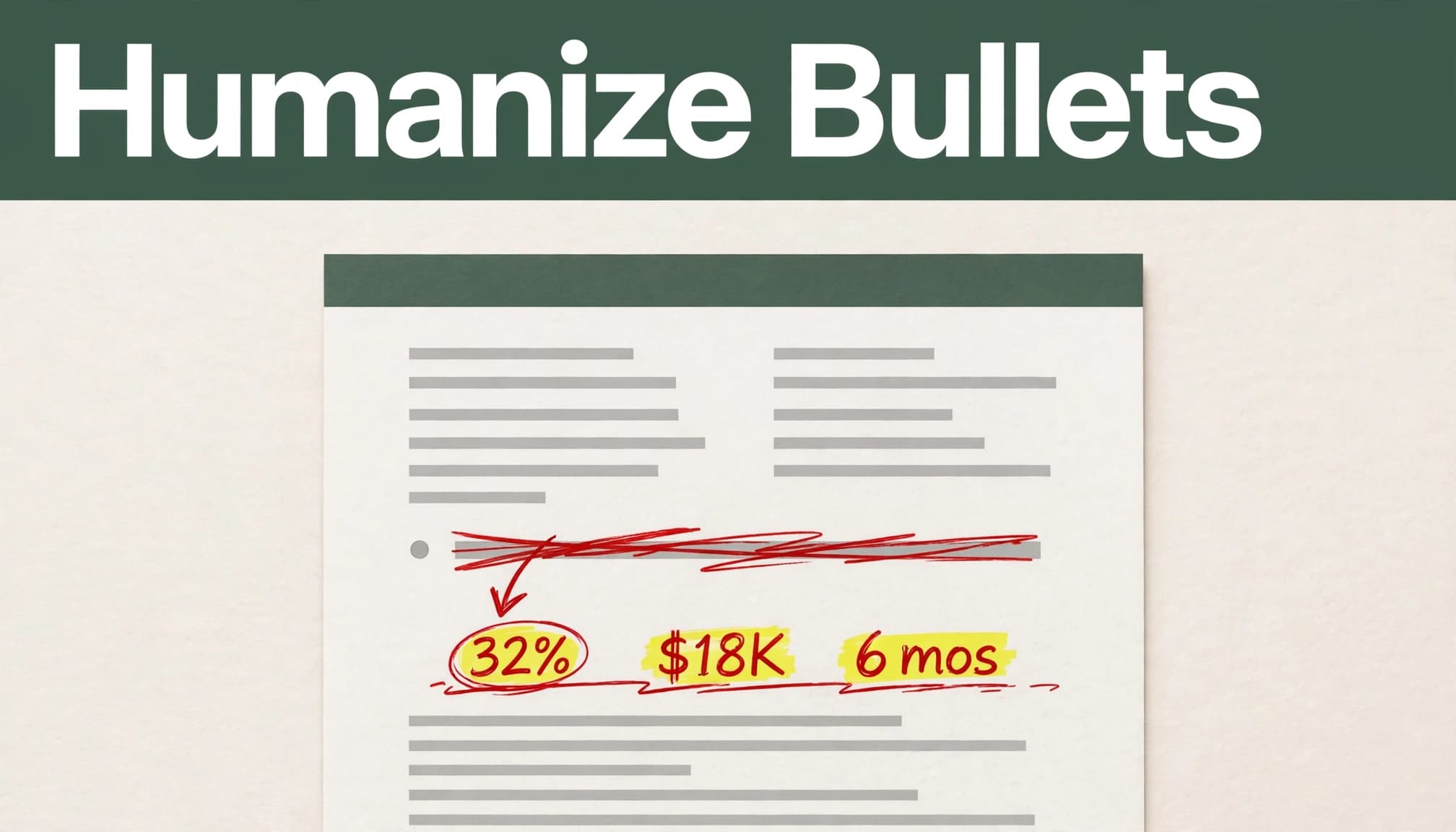
Phrases such as "results-driven professional," "strategically leveraged," and "responsible for optimizing" rarely establish credibility. They state an intention or trait, not a record of work.
Recruiter-friendly wording names the real assignment. It may identify the audience, workflow, software, decision, or constraint that shaped the work. "Improved customer engagement" becomes more useful when it identifies the channel, the action taken, and a verified result.
Weak AI bullets also stack abstractions. A line describing "cross-functional synergy to drive operational excellence" asks the reader to decode it. "Coordinated weekly release updates with support and engineering" says what happened.
Applicant tracking systems usually parse a resume's sections, keywords, formatting, and relevance to the role. A February 2026 Artech explanation of ATS parsing notes that ATS platforms focus on structure and keyword relevance rather than determining whether a document was written by AI.
Human readers face another question. Recruiters may recognize predictable phrasing, inconsistent seniority, or accomplishments with no credible detail. ChatGPT resume detection tools and other AI detection systems can flag predictable language, but they're not a reliable basis for evading screening. The practical risk is ordinary scrutiny when hiring managers ask follow-up questions about unsupported claims.
A bullet does not need to sound casual to sound human. It needs to describe work the candidate can explain with confidence.
The most reliable way to humanize AI-generated resume bullet points begins before the rewrite. Candidates should build a small evidence bank before editing resume bullet points, using performance reviews, project notes, portfolios, calendars, dashboards, and past resumes.
For every role, write four factual notes: the action taken, the scale of work, the tools or methods used, and the outcome. The outcome can include quantifiable achievements when records support them. It can also describe process improvements and other measurable results, such as fewer handoffs or faster reporting.
Capture hard and soft skills in the same evidence bank. Tools and methods can demonstrate hard skills, while collaboration, training, issue resolution, and communication can show soft skills.
For example, a retail operations employee might have trained new staff, managed stock counts, and resolved delivery problems. Those facts offer more material than asking an AI tool to “write powerful bullets for retail.”
The record should also distinguish individual contribution from team output. “Supported a campaign that generated [verified result]” is accurate when the candidate assisted. “Generated [result]” claims direct ownership and needs proof.
A good edit often begins with deletion. Cut unsupported adjectives, generic leadership claims, and vague references to innovation. Then choose a direct verb that matches the candidate’s actual authority: built, analyzed, scheduled, revised, reconciled, presented, trained, or resolved.
Numbers should clarify the scale of work, not turn every bullet into a sales pitch. A monthly reporting cycle, portfolio size, turnaround time, or training group can be useful evidence when records support it.
When a number is uncertain, leave a bracketed note such as [confirm average weekly volume]. Candidates should confirm metrics and scope rather than let an AI tool invent achievements. That is more responsible than submitting a plausible-looking metric that cannot survive a reference check.
Resume tailoring changes emphasis without rewriting a candidate's history. A personalized resume puts the most relevant, truthful evidence first.
Mark required skills, repeated verbs, proof points, industry-specific terminology, and language about the team's work. Use that terminology only when it accurately describes the applicant's experience. If a role repeatedly mentions Salesforce, renewals, and cross-functional communication, those terms belong in the resume only if the applicant has done that work.
One accurate mention is often enough. Repeating the same keyword several times can make a work experience section read like a search result. A 2025 study on matching resumes to job descriptions shows why alignment matters, but alignment depends on meaningful evidence rather than copied terminology.
Candidates changing careers can use the same method. A hospitality supervisor seeking a customer success role may draw on account follow-up, issue resolution, scheduling, and retention-related work. The resume should not imply formal SaaS experience that never existed.
The same role can support different applications when the evidence is real. These versions require the bracketed details to be replaced with verified information.
Target application | Generic AI-style bullet | Human-sounding, tailored revision |
|---|---|---|
Marketing coordinator | "Leveraged digital strategies to improve engagement." | "Prepared email and social campaign reports in [platform], using weekly engagement data to recommend [verified adjustment]." |
Project coordinator | "Managed projects and collaborated with stakeholders." | "Tracked [number] active requests in [tool], coordinated deadline updates with sales and support, and flagged delivery risks for the project lead." |
Customer success associate | "Enhanced client relationships and drove retention." | "Logged renewal outreach in Salesforce, followed up on unresolved account questions, and shared recurring customer issues with the support team." |
The revisions retain relevant hard and soft skills, yet they show those skills through work. The work experience section should avoid repeating keywords without evidence. "Stakeholder communication" becomes a deadline update. "Attention to detail" becomes accurate tracking or reconciliation.
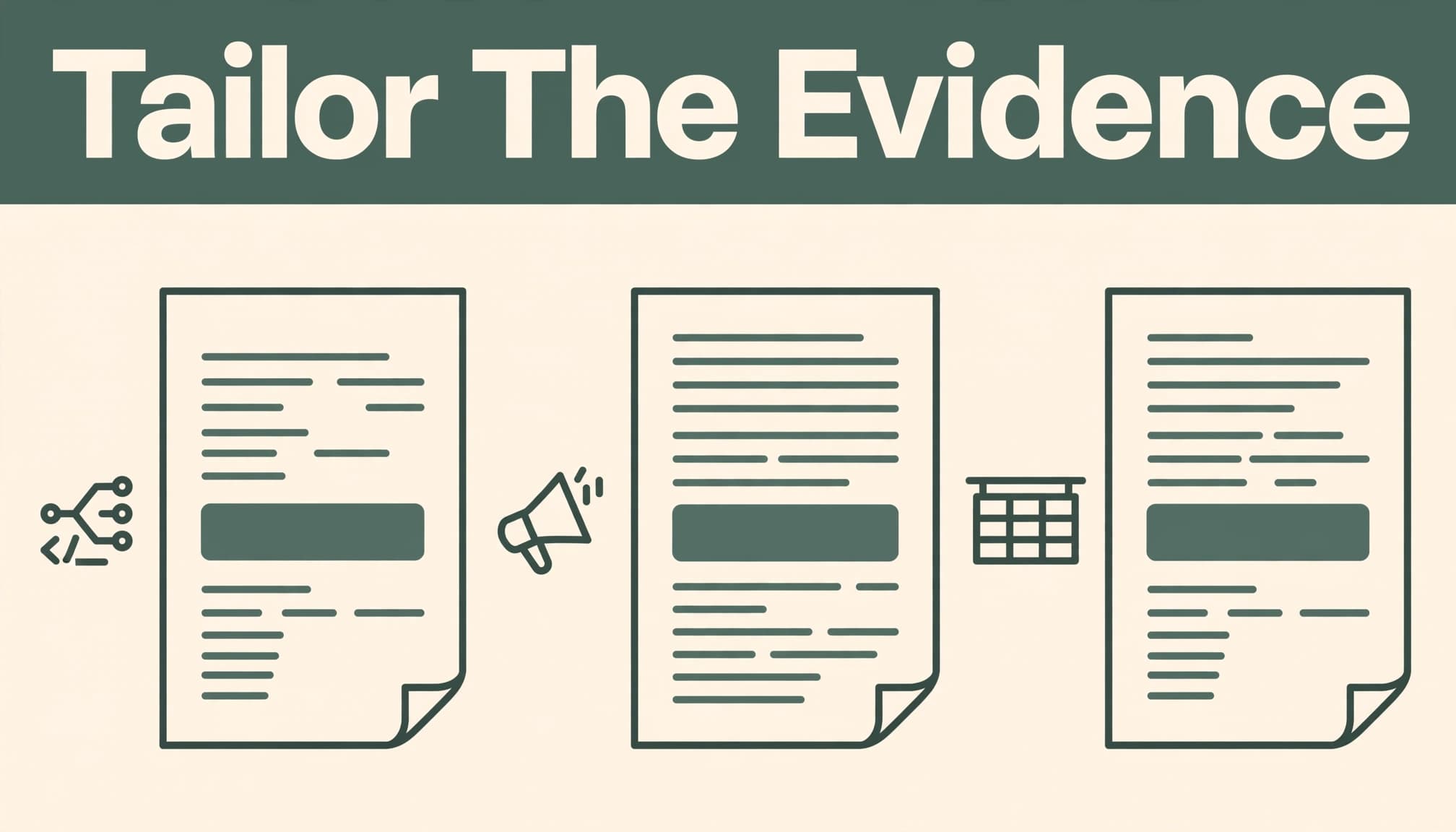
Prompts work best when they limit AI to supplied facts. An AI resume builder, AI writer, or cover letter generator can produce stronger drafts when candidates provide source material and explicit boundaries.
Rather than requesting a final bullet immediately, ask for the missing details. This reduces the chance that the model will fill gaps with invented accomplishments.
"Using only the facts below, list the action, scope, tools, collaborators, and outcomes for this role. Do not add metrics, software, credentials, or management responsibilities. Put brackets around information that is missing."
The response becomes a fact-checking worksheet. It can also support interview prep, since candidates can verify and discuss each action, tool, and outcome.
Candidates can then add their own notes before generating resume bullet drafts.
A second prompt should name the target role and preserve the candidate's authentic voice. It should also prohibit buzzwords that often appear in AI-generated resumes.
"Rewrite this resume bullet for a [job title] application. Preserve my authentic voice and use only verified details provided below. Do not add unsupported metrics, credentials, software, or management responsibilities. Start with a concrete action verb, include relevant job-description terms once where natural, and keep it under 28 words. Avoid 'leveraged,' 'results-driven,' 'dynamic,' 'synergy,' and unsupported claims. Provide two options with different sentence structures."
This approach gives job seekers alternatives without treating the model's output as final copy. A useful draft may still require substantial cuts.
Applicant tracking systems reward clear structure and relevant terminology. Effective resume optimization makes relevant terms easy to find while keeping recruiter-friendly wording tied to evidence, not repetition.
When a listing calls for SQL, Tableau, dashboard development, and stakeholder communication, qualified applicants can use that industry-specific terminology in evidence-based bullets. “Built weekly Tableau dashboards for regional sales leaders” is stronger than a skills list that repeats dashboard development several times.
The professional summary should follow the same rule. It can name a target function and two or three real hard and soft skills, while the work experience section supplies proof. Keyword stuffing weakens both sections because it separates the terms from the work.
Keep resume formatting simple with standard headings, consistent job titles, ordinary fonts, and clear dates. Avoid columns, graphics, text boxes, and unusual symbols when an application system may need to parse the document. Custom sections are acceptable when their labels, dates, and content remain clear to a parser.
A pre-submission scan can catch formatting or missing terminology. Kickresume describes its ATS resume checker as a tool used by more than 8 million job seekers, while Resumly offers a free ATS checker that reviews parsing, keywords, and formatting. Such tools can identify issues, but they can't validate a claim's truthfulness.
The last review should be slower than the drafting phase. Candidates should compare every bullet with their resume record, portfolio, manager feedback, or work artifacts.
Each line needs a clear answer to four questions: Did this happen? Did the candidate perform this part? Is the tool named accurately? Can the candidate discuss it in an interview?
Before submitting, run the resume through an ATS resume checker. It may flag parsing issues, formatting problems, or missing terminology. It can't confirm the candidate's actual contribution or prepare answers for a recruiter.
Tone also needs to remain consistent across the resume. An entry-level applicant shouldn't sound like a senior executive in one bullet and a student in the next. The writing can be professional without borrowing language the candidate would never use.
Confidential details require care as well. Internal revenue figures, client names, unpublished product plans, and personal data shouldn't be pasted into public AI tools without approval.
Reading aloud exposes repetitive openings, stiff verbs, and sentences that run too long. It also helps candidates recover a natural cadence after a tool has smoothed every line into the same rhythm.
Resources on how to make writing more natural can help identify awkward construction. Reading aloud is also useful interview prep because applicants should state each bullet naturally and explain its details without relying on memorized AI wording.
Recruiters may not know which tool produced a draft. ChatGPT resume detection discussions don't replace human review of specificity, consistency, and defensible accomplishments. AI assistance matters less than whether the final resume is accurate and specific.
Only metrics that add context belong in a bullet. One verified number is usually enough. Candidates can also show impact through scale, frequency, software used, a process changed, or a clearly defined responsibility.
A rewriting tool can improve flow and remove repetitive phrasing. It can't add firsthand experience, verify a metric, or decide whether a claim reflects the candidate's role. Using your own evidence also strengthens interview prep because you can explain the work behind each bullet. Authenticity comes from the candidate's evidence and final judgment.
The best resume bullets show actual work: clear actions, relevant context, and outcomes that hold up under follow-up questions. They also serve as interview prep because you should be able to explain the tools, decisions, and results behind each claim.
Humanized writing is not a disguise for AI output. It turns a fast draft into an honest, job-specific account of professional experience that you can defend.