
How to Edit AI Sustainability Claims Without Greenwashing
Editing AI-generated sustainability claims requires an evidence review before a style edit. Every environmental benefit needs a defined subject, a defensible measurement basis, and qualifications that survive the rewrite.
AI can turn a narrow material specification into a sweeping promise about a product or business. Smoother language can increase that risk when it removes boundaries, eroding consumer trust. The review therefore starts with what the evidence establishes, before considering how persuasive the sentence sounds.
Key Takeaways
Match every environmental assertion to evidence that supports its exact scope.
Preserve material qualifications, including comparison baselines, disposal conditions, and measurement periods.
Treat certifications, offsets, and regulatory requirements as separate subjects with distinct limits.
Where AI Sustainability Claims Go Wrong
Greenwashing includes vague claims, hidden trade-offs, unsupported labels, and selective disclosures that create a misleading overall impression. A technically correct detail can still support a misleading advertisement.
For example, evidence about recycled packaging doesn't establish that the packaged product is sustainable. Similarly, an emissions-reduction target or net-zero pledge doesn't establish that reductions have already occurred.
AI-assisted editing can introduce these errors through small substitutions that produce unsubstantiated claims. "Lower manufacturing emissions" becomes "lower environmental impact." "Industrially compostable" becomes "compostable." "Plans to reduce emissions" becomes "reduces emissions."
Each change broadens the original claim. The same risk applies to imagery: leaves, ocean scenes, and certification-like seals can imply benefits the accompanying evidence doesn't establish.
The editorial test is the message conveyed by the complete advertisement, including its headline and visuals. A qualification buried in supporting copy may not correct broader environmental claims.
A Six-Step Review Workflow
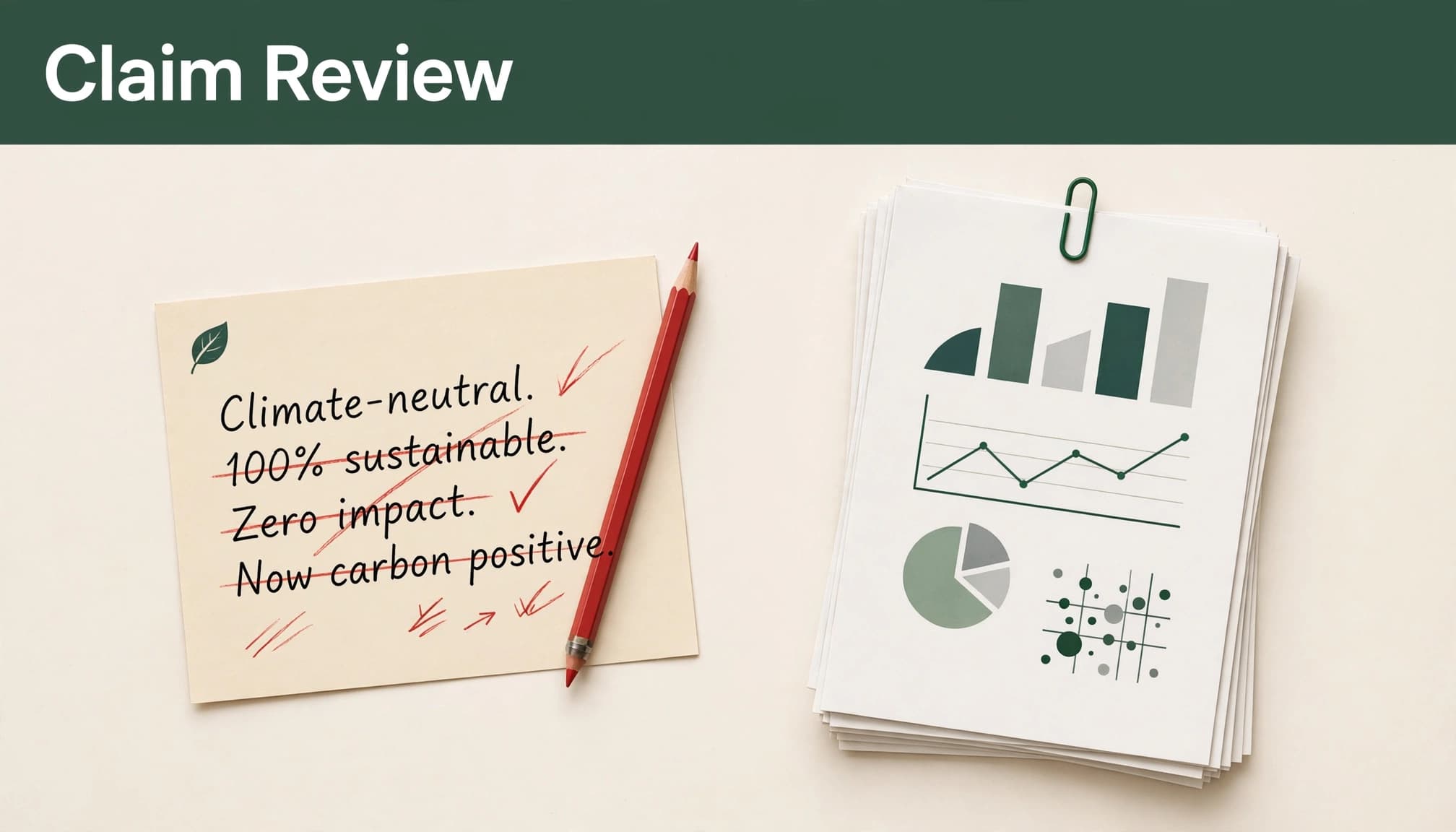
Our guidance on finding unsupported AI claims starts with separating plausible language from documented facts. Environmental copy needs the same discipline, with closer attention to scope.
Extract every consequential assertion. Record environmental adjectives, percentages, comparisons, disposal instructions, certifications, and future commitments in a claim sheet. Include headlines, captions, and image implications.
Define the subject and boundary. Identify whether the statement concerns a material, package, product, facility, or entire business. Record the geography, measurement period, and relevant exclusions.
Match each assertion to primary evidence. Attach the underlying test, supplier record, assessment, certificate, or audit. A working citation isn't enough; its contents must support the adjacent wording.
Resolve the evidence gap. Retain directly supported statements, narrow conditional findings, and remove contradicted or unsupported assertions. Replacing "sustainable" with "more sustainable" doesn't supply a comparison.
Rewrite within the approved boundaries. Preserve numbers, uncertainty, technical terminology, and conditions. An AI instruction should prohibit new benefits, inferred certifications, and stronger causal language.
Approve the finished publication. Sustainability specialists review technical meaning; legal reviewers assess exposure; editors inspect the complete presentation to safeguard consumer trust. Retain approved wording, sources, dates, and version history. Keep confidential supplier records out of unapproved prompts.
Unsubstantiated claims without usable evidence fail this review, regardless of their readability score.
What Counts as Substantiation
Life Cycle Assessments and EPDs
A life cycle assessment, or LCA, analyses environmental impacts across defined product-life stages. It can support comparison with a standard alternative when both assessments use compatible boundaries and equivalent functions.
ISO 14040 and ISO 14044 establish the LCA framework. The European Commission's Joint Research Centre explains these foundations in its life cycle assessment handbook.
Environmental Product Declarations, or EPDs, present LCA-based information under product-category rules; ISO 14025 covers Type III environmental declarations. An EPD discloses measured impacts. It doesn't automatically establish environmental superiority.
Editors should preserve the assessed impact category. Lower greenhouse-gas emissions don't establish lower water use or reduced toxicity.
Independent Review and Credible Certification
Third-party verification and auditing strengthen evidence when reviewers have relevant competence and a defined scope. They don't validate claims outside that scope.
A credible certification record identifies the standard, scheme owner, certificate holder, covered products, validity period, and verification process. Published criteria, independent assessment, and a searchable certificate register make its meaning inspectable.
Accreditation also needs a scope: a laboratory's competence for one test doesn't establish competence for every environmental assessment.
A self-declared leaf emblem has none of these properties unless supporting documentation establishes them. Editors should describe the verified attribute rather than converting a narrow certificate into broad, verified claims about an entire product range.
Before-and-After Edits That Preserve Scope
These before-and-after greenwashing examples show how rigorous editing preserves technical scope.
Material Origin: Ocean-Bound Plastic
Before: "100% ocean plastic."
After: "These tubs use recycled ocean-bound plastic collected within 50 km of the Malaysian coastline."
The ACCC accepted an undertaking from MOO Premium Foods in November 2023 after investigating its ocean-plastic marketing claims. The material came from plastic collected near the coast, rather than plastic recovered from the ocean.
The revised wording preserves the documented collection origin without implying ocean cleanup. Any percentage requires separate evidence about the relevant component and material content. "Made using" doesn't establish that every packaging component contains that material.
Disposal Conditions: Industrial Composting

Before: "Compostable capsules."
After: "Capsules certified for industrial composting. This certification doesn't establish home compostability."
In April 2025, the UK Advertising Standards Authority upheld complaints about Lavazza's Eco Caps advertising because the capsules required industrial composting.
Industrial facilities control processing conditions that backyard compost heaps don't reliably reproduce. Certification for industrial treatment therefore cannot substantiate a home-compostable claim.
The disposal route also matters. Technical compostability doesn't establish that local collection services accept the item.
Removing "industrial" during a readability edit changes the disposal claim, not merely its style.
Enforcement Cases Show What Editors Must Catch
Recent greenwashing fines demonstrate what editors must catch before marketing copy goes live.
Fashion Claims and Supply-Chain Evidence

Italy's AGCM imposed a EUR 1 million fine on Shein's European operator in August 2025. Its Shein enforcement notice addressed environmental messaging around evoluSHEIN by Design, including circularity and recyclability. Claims about selected materials couldn't establish broad benefits across the business.
Also in August 2025, AGCM fined Giorgio Armani and G.A. Operations EUR 3.5 million, approximately USD 4 million. The Armani decision concerned ethical claims and social responsibility, against evidence of illegal labour practices in supply chain workshops.
That was an ethical-marketing case rather than an environmental penalty. These enforcement actions illustrate how greenwashing fines attach to claims that lack verification across operations. The editorial lesson is relevant: a corporate promise needs evidence across the operations and supply chain it describes.
Omitted Impacts, Unsupported Comparisons, and Offsets
In October 2022, the Advertising Standards Authority (ASA) upheld complaints about HSBC bus-stop advertisements. Its HSBC advertising ruling found that the ads omitted material information about financing high-emitting industries, including thermal coal and fossil fuels.
In December 2023, the Advertising Standards Authority ruled against Lufthansa's unqualified Google advertisement, "Fly more sustainably." It lacked an explained comparison basis and couldn't reappear in that form.
In August 2025, Frankfurt Regional Court barred Apple's Apple Watch carbon neutral product claim in Germany. The dispute included forestry-offset leases that weren't guaranteed beyond 2029.
The Amsterdam District Court also found several KLM advertisements misleading in March 2024. Together, these cases show why regulators levy substantial fines when limited initiatives cannot support unrestricted environmental promises.
Canadian and EU Rules Require Accurate Dates
Canada's Substantiation Requirements Changed Again
Canada amended its Competition Act through Bill C-59 in June 2024, introducing stricter legislation for commercial green assertions. The provisions required adequate and proper testing for specified product-benefit claims and adequate and proper substantiation for specified business or business-activity claims.
Scientific evidence, testing, and relevant data provide a defensible foundation. Vague reassurance doesn't.
However, the legal wording changed again in March 2026. Bill C-15 removed the requirement that business-level proof use an internationally recognized methodology. The underlying evidentiary obligation remains, as the Competition Bureau's environmental-claims guidance explains.
ISO-aligned methods remain useful evidence frameworks. Editors shouldn't describe every ISO methodology as a universal statutory requirement.
EmpCo Applies From September 2026
The EU adopted Directive (EU) 2024/825, commonly called EmpCo, in 2024. Its application date was September 27, 2026.
The European Commission's EmpCo guidance addresses restrictions on generic environmental claims, sustainability labels, and product climate-neutral claims based on carbon offsetting. Alongside EmpCo, the EU's planned Green Claims Directive sets higher bars for environmental substantiation.
Corporate climate disclosure mandates are a separate obligation. A Trellis disclosure survey counted mandates in the EU, 10 other countries, and California, with six further entities considering them. That published tally is a reporting snapshot, not a current legal inventory.
An ESG report can supply evidence. Its existence doesn't substantiate every marketing statement drawn from it.
Frequently Asked Questions
Is ESG Reporting Greenwashing?
ESG reporting isn't inherently greenwashing. It becomes misleading when selective information, unsupported conclusions, or omitted limitations create a false impression. Editors should retain the reporting boundary, measurement period, and distinction between targets and achieved results.
Can AI Approve Environmental Copy?
AI can extract assertions and flag missing qualifications. It can't assume accountability for technical or legal approval. Our AI content QA rubric separates accuracy from readability and treats unsupported consequential claims as publication failures. A fluent rewrite doesn't resolve missing primary documentation.
Stronger Editing Produces Narrower, Defensible Claims
The strongest environmental claims state what the evidence establishes and stop at that boundary. Their precision depends on keeping conditions visible through every revision.
AI can improve structure and readability, but approved meaning must remain intact. A narrower, supported statement protects credibility and offers more useful information than a broad promise the records cannot defend.