
Edit AI Google Ads for Policy-Compliant Claims
Editing Google Ads claims starts with evidence: every promise must match what the advertiser can support and what the landing page offers. AI-generated wording follows the same advertising policies as human-written copy.
A fluent draft can still invent a guarantee, exaggerate a customer result, or omit a price condition. The essential edit is an evidence-based review, followed by a review of wording across the entire customer journey. That review begins with the meaning of the promise.
Key takeaways
Google reviews claims in ads and destinations, so changing a headline alone may leave the underlying problem unresolved.
Qualifiers such as "may" and "up to" don't make an unsupported outcome acceptable.
Effective editing preserves evidence, eligibility conditions, and pricing terms through every rewrite.
Start with the policy behind the promise
Unreliable claims include improbable outcomes
Google's Unreliable claims policy prohibits inaccurate claims and improbable outcomes presented as likely results. An outcome can be technically possible yet still create a misleading expectation.
Editors therefore need to examine the overall message, not just words such as "guaranteed." A testimonial describing exceptional results can imply that ordinary customers should expect the same outcome. Replacing a guarantee with "can deliver" may leave that implication intact.
Google doesn't provide a separate compliance route for AI-written advertisements.
Evidence must support the advertised meaning
A product specification supports a feature claim. However, it doesn't establish that the feature increases revenue or reduces costs. Those outcome statements need evidence matching their scope and conditions.
Health-related advertising requires particular care. The FTC's health-products guidance calls for competent and reliable scientific evidence. Customer anecdotes don't establish that a product prevents or treats a condition.
Financial, legal, and safety claims also warrant specialist review. An editor shouldn't preserve a statement merely because it makes an effective headline.
Use a four-step review before rewriting

AI drafts become easier to assess when editors separate claims from surrounding promotional language.
Extract each material assertion.
Record performance promises, prices, comparisons, certifications, and eligibility statements. Include implied promises in testimonials and images, not just explicit assertions.
Attach an evidence record.
Identify the approved product document, pricing record, research, or customer authorization supporting each statement. Record its date and the passage that supports the proposed wording.
Choose an editorial action.
Retain supported statements, narrow overbroad ones, and remove unsupported promises. When an outcome lacks evidence, a documented feature may provide a useful replacement.
Compare the revision against its source.
Preserve numbers, timeframes, geographic restrictions, and uncertainty. Then review the ad alongside its destination before approval.
This evidence record should distinguish a verified feature from a customer opinion or an inference. A quotation can accurately describe one customer's experience without supporting a universal performance claim.
Our guidance on testing rewrites for meaning drift addresses this final comparison. Small wording changes can expand a claim even when most of the sentence remains unchanged.
The workflow also needs an accountable approver. Automated checks can flag suspicious language, but they can't establish whether supporting evidence is adequate.
Edit headlines and descriptions without losing conditions
Headlines need a supportable promise
Responsive search ad headlines allow up to 30 characters. That limited space makes sweeping promises tempting, but it doesn't excuse misleading shorthand.
For an AI text-rewriting tool, this edit replaces an approval promise with a service description:
Before: "Guaranteed Ad Approval"
After: "AI Text Rewriting Tool"
The revised headline describes the service without suggesting control over Google's review decision. It's a narrower claim, not an assurance that the complete advertisement will receive approval.
Editors should also review responsive search ad combinations. A headline must remain accurate when Google pairs it with other eligible assets.
Descriptions must preserve the claim's limits
Responsive search ad descriptions allow up to 90 characters. That space can explain the offer, but it shouldn't carry a stronger promise than the evidence supports.
Before: "Make any AI ad fully compliant instantly."
After: "Rewrite AI-generated text for a more natural tone. Review claims before publishing."
The revision separates writing assistance from compliance approval. It also removes "any" and "instantly," which broaden the original promise.
Conditions that change the offer's meaning belong in the relevant asset. Editors shouldn't assume that a separate description will always appear beside a headline requiring qualification.
Make the landing page support the advertisement
Match the offer across the destination
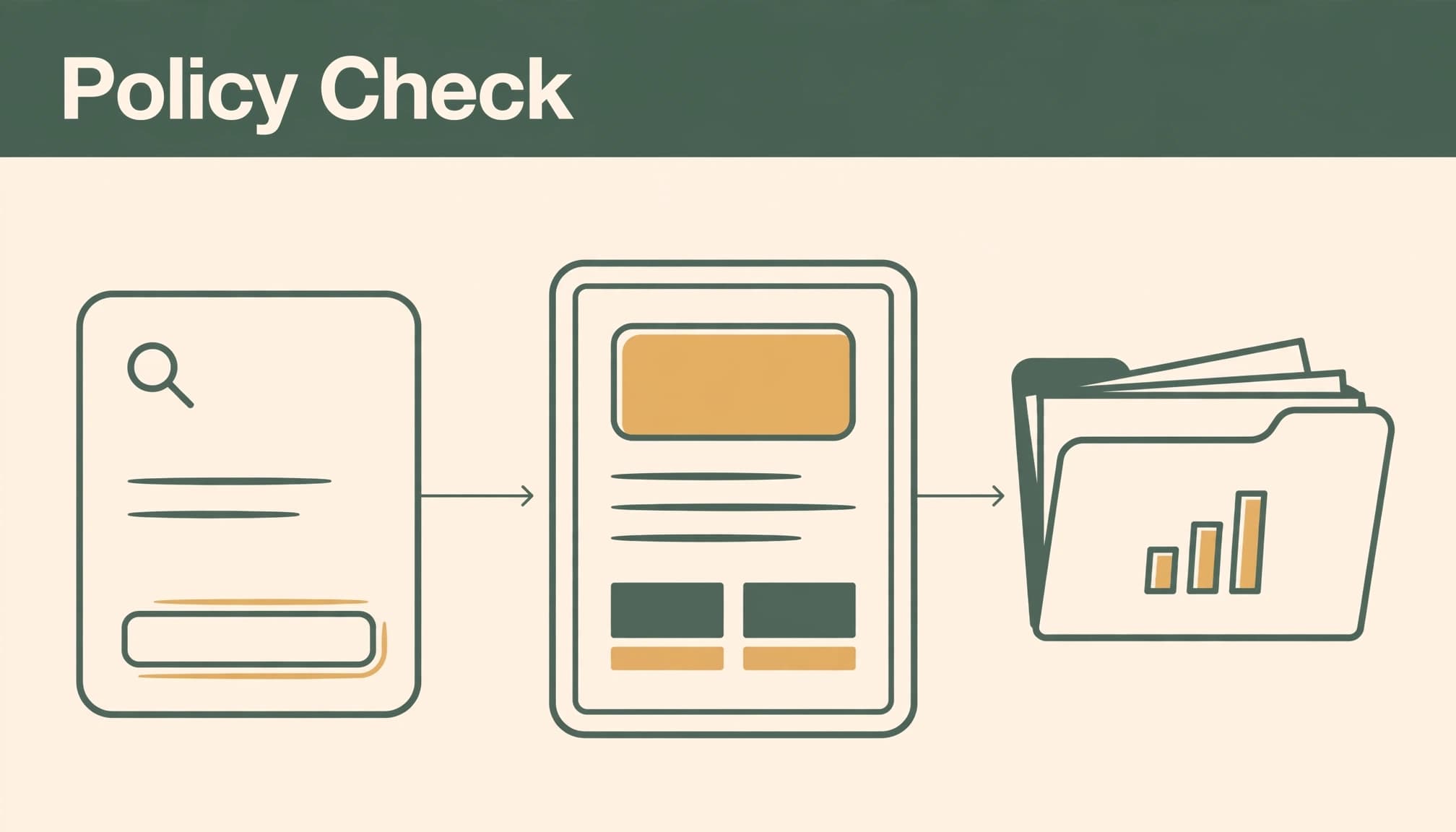
Google's misrepresentation rules cover misleading information and material omissions in ads and destinations. A restrained advertisement can still lead to a page containing unsupported guarantees.
For our platform, an AI draft describing access as "Unlimited Free Access" would misstate the offer. "Free Limited-Use Access" preserves the actual restriction.
The same comparison applies to subscription terms, eligibility, and availability. Landing-page headings, pricing panels, forms, and checkout language should describe the same offer. An accurate explanation buried elsewhere doesn't remove a misleading impression at the point of decision.
Keep evidence beside consequential claims
A performance claim needs enough context for its meaning to remain accurate. Relevant details may include the measured population, comparison period, methodology, and limitations.
Case studies need particular attention. A documented customer result shouldn't become an expected result for every buyer. Similarly, a rewrite must preserve the distinction between correlation and causation.
Adding "results may vary" doesn't supply evidence for the result advertised.
Editors should also inspect graphics and comparison charts. Visuals can imply superiority or certainty without stating either in a sentence.
Use current Google policy resources and review routes
The Google Ads policy center is the starting point for current requirements. Within it, Misrepresentation and Unreliable claims address the central issues discussed here. Product-specific policies can impose additional restrictions.
For a disapproved advertisement, the policy label shown in the Google Ads account narrows the investigation. The review should cover the flagged asset, destination, and relevant policy examples.
Saving an edited ad or asset sends it for review. Google's Unreliable claims guidance describes a typical review period of 24 to 48 hours. An advertiser who believes the decision is incorrect can appeal through the account.
A useful appeal identifies the disputed claim and explains the correction or supporting evidence. Repeatedly changing synonyms without addressing the promise leaves the substantive issue intact.
Teams should retain the original draft, approved revision, evidence record, and decision history. Our AI content governance guidance connects those records with review responsibilities and approval rules.
Separate policy claims from compensation claims
Searches for Google Ads claims also surface litigation and billing disputes. Those matters follow different processes from advertising-policy review.
The advertiser class action concerns historical purchases
Reuters reported the $100 million settlement in March 2025. The action, filed in 2011, covers advertisers who used Google between January 1, 2004, and December 13, 2012.
The allegations concerned clicks outside targeted geographic areas, representations about Search Network and Display Network value, and unapplied Smart Pricing discounts. These allegations concern Google's advertising services, rather than promises written by advertisers.
Don't describe these allegations as involving minimum bid thresholds unless the underlying filings support that description. Any arbitration clause or process is separate from this class-action route and should be described only with reference to the relevant agreement or case record.
Antitrust intake is a separate legal route
Keller Postman's overcharge case says qualifying businesses that purchased Google ads on or after August 2016 may pursue compensation. The firm advertises potential recoveries of $10,000 or more, depending on ad spend, with no upfront cost and a contingency fee only if compensation is secured.
Its intake sequence is to complete a form, describe what happened, review and sign documents, then allow the firm to handle filing and negotiation. That's a representation process, not a guaranteed award.
AdTrader alleged failures to refund invalid clicks
The 2017 AdTrader lawsuit report described allegations that Google didn't refund advertisers for invalid or fraudulent clicks. Google denied the claims.
The suit cited a 2014 report that AdX generated $1 million per hour for publishers. That historical revenue figure doesn't establish an individual advertiser's loss or refund entitlement.
Recovery figures also need careful qualification
Legal advertising provides another example of why AI-generated numbers need editing.
In the $100 million settlement, plaintiffs' counsel sought approximately $33 million in attorneys' fees and up to $4.2 million in expenses. Subtracting both amounts leaves $62.8 million before other costs. That arithmetic isn't an individual payout estimate.
The settlement allocation filing addresses distribution after court-approved deductions. Distribution is made on a pro rata basis according to relative eligible losses; court approval precedes distribution.
Separately, Keller Postman's illustration of a 10% overcharge with trebled damages produces 30% of spend. Applied to $10,000, that's $3,000 before fees, not evidence of a $10,000 recovery. AI copy must preserve the assumptions behind that calculation.
Frequently asked questions
Can an ad without outcome language receive an unreliable claims flag?
Yes. Review includes the destination, where testimonials, graphics, or other statements may create an unsupported expectation. The headline alone doesn't determine the complete message.
A flag also doesn't establish which sentence caused the decision. The relevant policy label and complete advertisement provide the basis for review.
Does a rewriting tool establish policy compliance?
No. A rewriting tool can improve phrasing, but it doesn't establish that a claim is true or adequately supported. An AI-detection score doesn't answer either question.
Billing disputes are separate as well. Google's charge dispute guidance addresses charges rather than advertising-copy approval. Neither a refund request nor a legal intake substitutes for correcting a misleading advertisement.
Accuracy must survive the final edit
Policy-compliant editing depends on the connection between a promise, its evidence, and the offer presented after the click. Better phrasing helps only when that connection remains intact.
Before publishing, confirm that:
Each promise has supporting evidence.
You've checked current, relevant Google Ads policy resources.
Headlines and descriptions preserve all qualifications.
The landing page matches the advertised offer and its conditions.
The strongest revision often makes a narrower promise. Supported specificity gives an advertisement something defensible to say without asking a disclaimer to repair an exaggerated claim.