
AI Script Fact-Checking Before a YouTube Recording
AI script fact-checking requires tracing factual statements to original evidence, then checking whether the narration preserves that evidence accurately. A chatbot's approval cannot establish that a quotation exists or that a statistic supports the argument.
The recording process raises the cost of mistakes: an unsupported sentence can reach the voiceover, graphics, thumbnail, and short-form clips. A reliable workflow starts with a claim inventory and keeps the evidence attached through the final edit.
Key Takeaways
Separate checkable claims before polishing the script's language.
Use AI tools to identify claims and locate evidence, while keeping approval with a human editor.
Review the finished video against the approved sources because editing can change meaning after the script passes review.
What AI Fact-Checking Research Establishes
Accuracy depends on the task and source access
The preprint Fact-Checking Using AI analyzed 1,555,281 English-language fact-check requests made on social media to Grok and Perplexity bots on X between February and September 2025.
Its researchers also benchmarked 19 frontier large language models (LLMs) against professional fact-checkers' evaluations of hundreds of news headlines. They found that model judgments could match or exceed agreement among professional fact-checkers.
That comparison measures agreement on selected headlines. It doesn't establish that a model can audit every quotation, calculation, and visual assertion in a YouTube production.
The preprint also found that disabling search or restricting sources, including through Truth Social AI, could degrade accuracy. Access to relevant evidence affects performance, although search access alone doesn't guarantee a correct assessment.
Audience trust and automation introduce separate risks
A preregistered experiment involving 1,592 participants found that identifying a fact-check as Grok's reduced belief updating among Democrats while increasing it among Republicans. The experiment measured changes in responses to information, not whether participants correctly identified false information or their general trust in AI.
A separate social-learning model examined a free, error-prone automated checker alongside costly but perfect manual checking. Under its assumptions, automation could reduce welfare for articles of intermediate reliability. It improved average outcomes over manual-only checking only above an accuracy threshold.
That is a theoretical result, rather than a measured error rate for creators. However, it identifies a production risk: cheap automated reassurance can displace a more demanding review.
Tools for AI Script Fact-Checking
These tools perform different jobs. The prices below are historical published snapshots, not confirmed November 2026 quotes.
GPTZero: authorship screening
Former journalism student Edward Tian launched GPTZero in January 2023. It initially targeted ChatGPT-generated content and later expanded to Bard and LLaMa.
GPTZero estimates whether writing resembles AI output; it doesn't verify facts. False positives require follow-up and independent diligence before work is discarded. Earlier pricing descriptions listed a limited free version and paid options ranging from $10 to $23 monthly.
Factiverse AI Editor: claim detection and evidence retrieval
Factiverse AI Editor uses machine learning trained on reputable reporting and professional fact-checkers' work. It searches fact-checking databases in real time and supports claims in more than 40 languages.
It performs best on well-covered subjects, including climate change and COVID-19. However, it cannot independently settle whether information is accurate. Editors must assess whether the retrieved evidence supports the script.
Earlier pricing descriptions included a 14-day trial, Lite at €10 monthly, Pro at €25 monthly, and team rates for groups of at least five.
HARO: access to human sources
HARO, or Help A Reporter Out, connects journalists with people who have expertise or firsthand experience. Poynter describes its role in finding sources for reporting.
Authenticated, attributed quotes can support verification and audience trust. The same source-vetting discipline used in newsrooms applies: assess an expert's credentials, conflicts, and supporting evidence before relying on a response.
Turn the Draft Into Checkable Claims
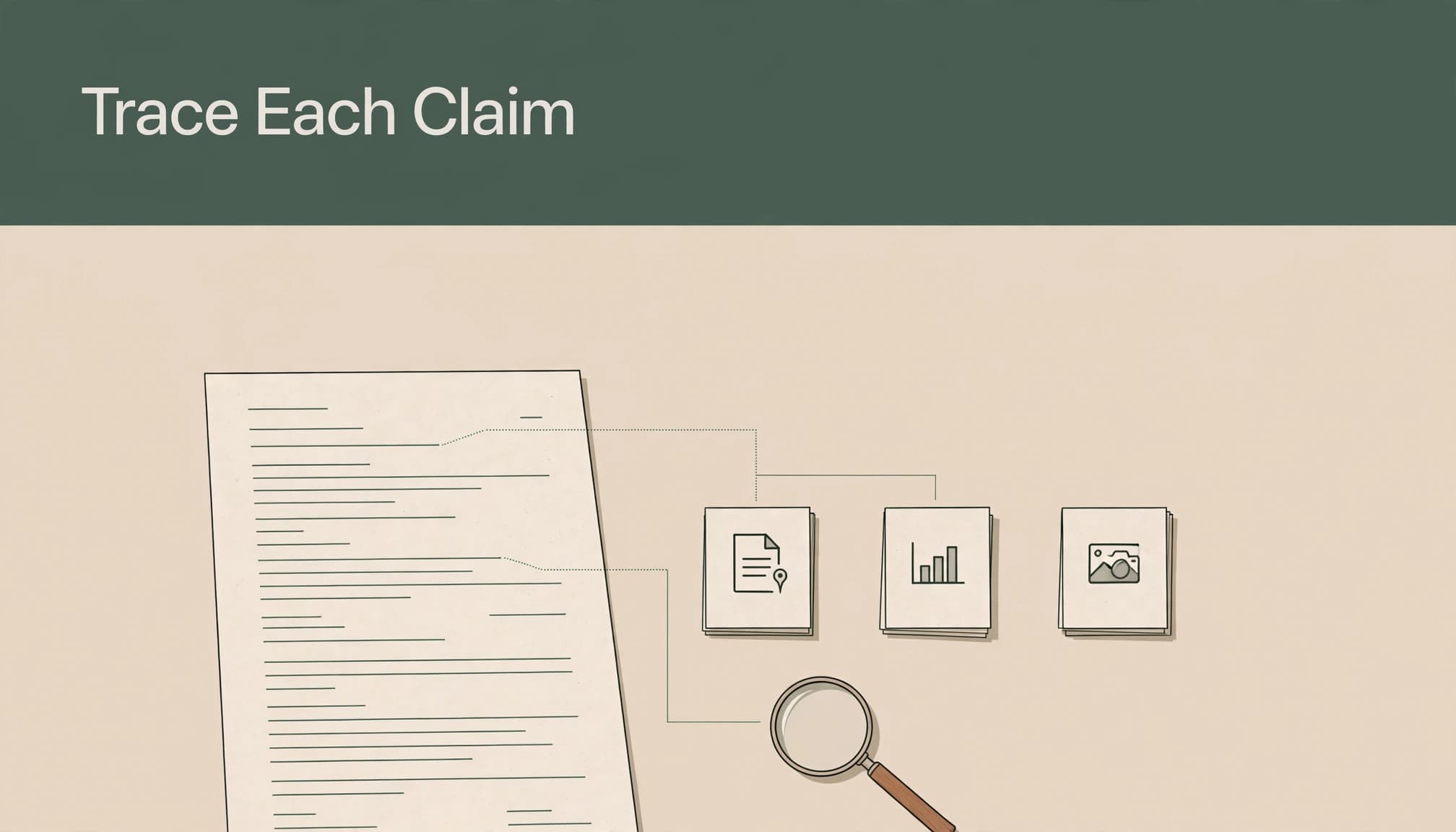
When reviewing AI generative content, first extract claims without rewriting them. A compound sentence may contain several assertions: a launch date, a performance comparison, and a claim about why something happened.
A repeatable extraction pass follows four steps:
Freeze a numbered draft so each claim retains a stable reference.
Extract factual assertions, including those in hooks, graphics, and planned captions.
Split compound statements into independently checkable claims.
Assign each claim a risk level and an initial status of unverified.
An AI assistant can help with extraction using a constrained instruction:
List every externally checkable assertion, preserve its wording and script location, and flag missing dates, populations, units, or attribution. Do not supply replacement facts.
The editor then compares the inventory against the full script. Automated extraction can overlook implied causation and broad words such as "first," "only," or "proven."
This inventory makes unsupported claims in AI-generated content visible before fluent narration makes them harder to notice.
Trace Every Claim to Original Evidence
Follow citations beyond the summary
Treat citations as leads: verify that reliable sources support the exact statement. For research claims, the strongest starting point is the paper itself, including its methods and limitations. For laws, product specifications, and financial results, check the relevant statute, documentation, or filing.
A news story can provide context, but several stories repeating one press release don't create independent confirmation.
Search-enabled tools such as Grok or Perplexity can locate documents. However, the editor must open those documents and identify the passage supporting the claim. A second model repeating the same answer adds little when both rely on the same underlying source.
Authenticate quotations and experience
Every direct quotation needs exact wording, an identified speaker, and its original context. Recorded interviews also need timestamps. Translated quotations should retain the original wording alongside the translation.
If the wording can't be located, remove the quotation marks. A paraphrase still needs evidence and accurate attribution.
The same standard applies to experience. AI-generated phrases such as "we tested" require a real test record. Without one, the script must describe the documented findings without implying firsthand work.
Check Statistics, Dates, and Missing Context
Recalculate what the number means
Statistics need a denominator, population, measurement period, and unit. Editors should also distinguish percentages from percentage-point changes and relative risk from absolute risk.
A documented example concerns misleading interpretations of the CDC's July 2021 Provincetown COVID-19 outbreak report. As FactCheck.org explained, the proportion of cases occurring among vaccinated people did not, by itself, measure vaccine effectiveness.
That distinction matters in scripts because compression can remove the denominator or comparison needed to interpret a figure.
An availability claim such as "99.9%" also needs its measurement window, covered service, and exclusions. The number alone cannot establish the full claim.
Preserve chronology and qualifications
Publication dates, event dates, and data-collection dates answer different questions. A newly published report can describe old conditions. Meanwhile, a script can confuse a product announcement with its release.
Context also changes through small edits. Replacing "associated with" with "caused" introduces a causal claim. Changing "in this test" to "always" turns a limited result into a universal statement.
Health claims deserve stronger review. A 2022 WHO review found that misinformation during outbreaks and disasters can harm mental health and hinder healthcare efforts. Clinical or safety guidance therefore needs appropriate subject-matter review before recording.
Keep a Source Log Through Production
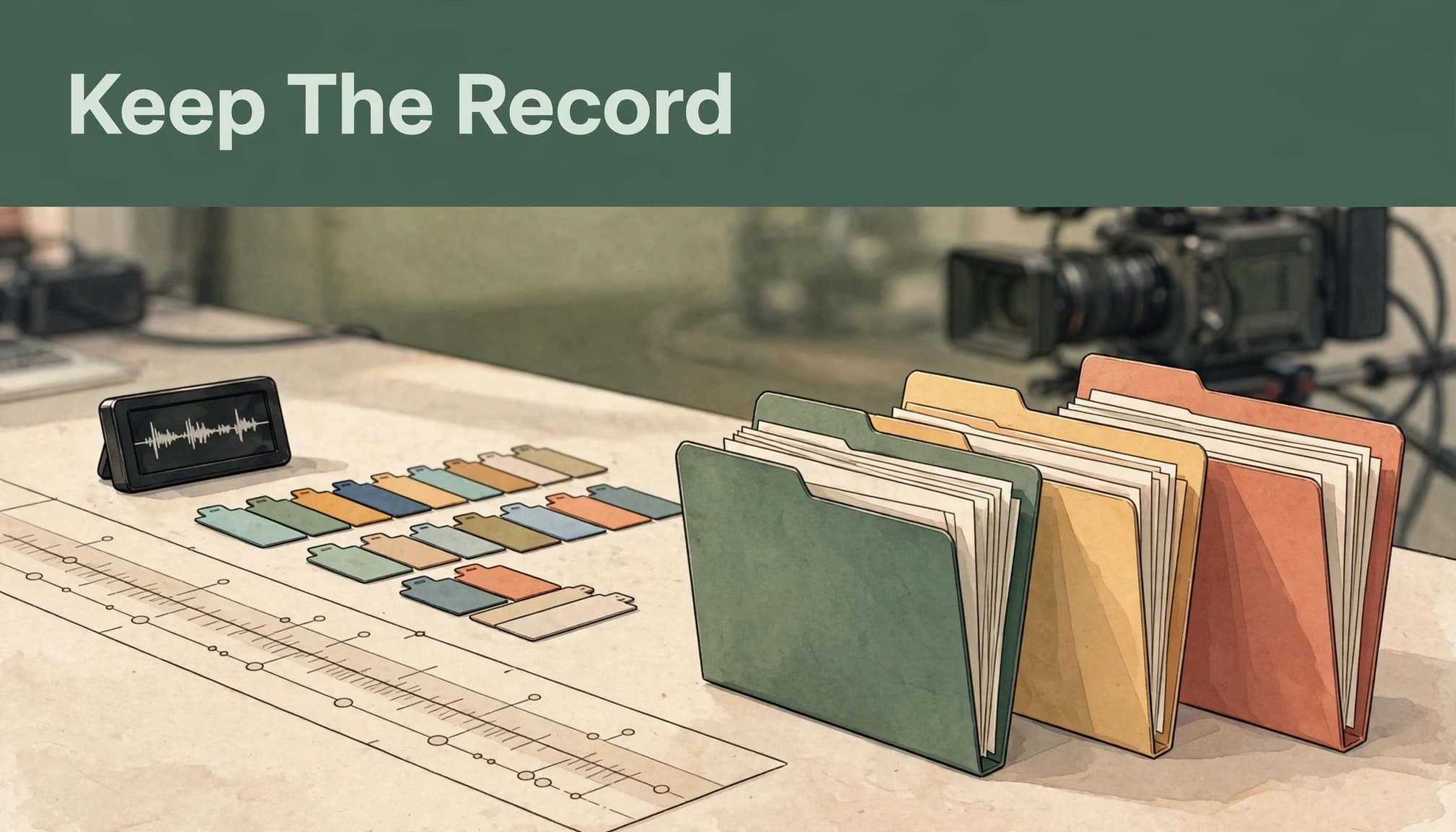
Record decisions alongside evidence
A spreadsheet can hold the source log. Its purpose is to preserve the connection between a sentence, its evidence, and the editorial decision.
Each entry needs enough detail for another producer to reconstruct the review.
Field | What to record |
|---|---|
Claim reference | Stable ID, script version, and exact wording |
Evidence | Source URL, title, publication date, and access date |
Supporting location | Relevant passage, page, table, or timestamp |
Decision | Supported, corrected, unresolved, or removed |
Accountability | Reviewer, review date, and approved wording |
This record preserves disagreements and unresolved questions. Approval should identify which wording passed review, rather than attaching a general "checked" label to the entire draft.
A shared AI content review rubric can define evidence standards and approval rules for higher-risk claims.
Reopen review when the production changes
Fact-checking belongs before recording and after substantive rewriting. Language edits can drop qualifications, change terminology, or separate citations from their claims.
The rough-cut review must cover narration, graphics, and footage. A correct tutorial voiceover can still mislead when the screen recording shows a different control or omits the confirmation step.
Titles, thumbnails, descriptions, and extracted clips also need review. If publication reveals a material error, the correction should identify the affected claim and explain the change. The source log preserves the record behind that correction.
Frequently Asked Questions
Can a second chatbot validate the first chatbot's script?
It can identify contradictions, suggest search terms, and surface missing evidence. Agreement between chatbots isn't independent confirmation. Both may reproduce the same mistaken source or unsupported assumption. The deciding evidence remains the original document and its relationship to the exact claim.
Does an AI detector establish whether a script is trustworthy?
No. Detection estimates patterns associated with generated writing. It cannot authenticate a quotation, establish firsthand experience, or verify a statistic. A low score doesn't establish accuracy, while a high score doesn't prove the facts are wrong. Authorship screening and factual review answer different questions.
Accuracy Depends on a Traceable Record
Reliable AI script fact-checking leaves a record: each factual sentence connects to evidence, and each substantive revision preserves that connection. Tools can accelerate extraction and search, but editorial approval still depends on what the sources establish.
For a YouTube production, accuracy survives through continuity. The approved script, recorded narration, and finished edit must make the same supported claims.