One webinar can supply a month of useful material for a broader content marketing strategy, yet many teams reduce it to a transcript cut into smaller pieces. The result is repetitive posts, weak search pages, and the sense that every channel says the same thing.
AI content repurposing works when it changes the editorial purpose of a source asset without changing its facts. The goal is not to produce more copy, but to give each audience a useful reason to encounter the idea again.
That distinction begins with a clear definition of originality.
AI content repurposing should give each asset a distinct audience question, format, or reporting context rather than create superficial copy variations.
A reliable workflow starts with a clean source of truth, channel-specific briefs, fixed editorial constraints, human review, and a record of every published asset.
Content repurposing tools can reduce transcription, clipping, formatting, scheduling, and handoff work, but editors must still verify context, facts, permissions, and brand fit.
Teams should protect originality and search visibility by auditing similar pages, updating outdated claims, using attribution correctly, and applying redirects or canonical tags when appropriate.
Legitimate repurposing takes one source asset and rebuilds it for a different context. Podcast repurposing might turn an episode into a concise newsletter, a search-focused blog update, a short video script, and an FAQ. Each piece draws on the same reporting or expertise, but answers a different reader need.
Duplicate content is substantially similar copy that appears at multiple URLs, often with no meaningful reason for the repetition. Search engines can select one version to show and ignore the others. As HostPapa's overview of duplicate content explains, duplication does not automatically trigger a penalty, but it can make it harder for a search engine to determine the preferred page.
Plagiarism is separate. It occurs when a writer presents someone else's language, ideas, reporting, or creative work as their own. Copyright is a legal issue involving protected expression and permission. A company can publish duplicate material that it owns, and it can also publish unique copy that improperly borrows from another source. Those problems overlap at times, but they require different fixes.
Artificial intelligence should support editorial transformation. It should not perform superficial synonym swaps or disguise borrowed material in hopes of escaping plagiarism or AI-detection checks. Cosmetic rewrites often preserve the source's structure, rhythm, and reasoning. They produce content that feels thin because it has no new editorial job.
A repurposed asset needs a new audience question, a new format, or new reporting context. Without one of those changes, it is usually a copy variation rather than a new piece.

A reliable content workflow begins with an audit of existing content assets. Teams should look for evergreen content with proven interest. Good candidates include high-performing webinars, detailed guides, customer interviews, and podcasts with durable advice. Time-sensitive announcements and pages with weak facts rarely warrant more attention.
Then, clean the source. Feed the model the transcript, article body, research notes, and approved quotations. Leave out page navigation, footers, old calls to action, and unrelated comments. A clean source packet reduces the chance that AI repeats boilerplate across every output.
The operating sequence is straightforward:
Define the source of truth.
Record the original URL, publication date, owner, primary claims, citations, and permissions for any third-party material.
Assign each output a distinct brief.
A LinkedIn post may explain one argument; an email may frame the same lesson around a current customer concern; a blog update may answer a search query the original page missed.
Give AI fixed editorial constraints.
Prompts should include approved terminology, banned claims, audience knowledge level, evidence requirements, tone, and intended format.
Review before design and scheduling.
Editors should approve the central point and factual claims before design or scheduling begins. Workflow automation can route drafts to the right reviewer. Video editors can use video clipping tools, but must check every clip for context before publication.
Log every published asset.
A simple Airtable, Notion database, or spreadsheet can serve as a lightweight content library. Track the source, angle, channel, URL, social media scheduling details, publish date, and next review date. Workflow automation can send reminders, log metadata, and manage handoffs, helping teams coordinate content distribution.
Technical SEO teams can use Builtvisible's duplicate-content audit guidance to identify pages that already compete with each other. The audit should happen before new pages go live, not after the site has accumulated a library of near-copies.
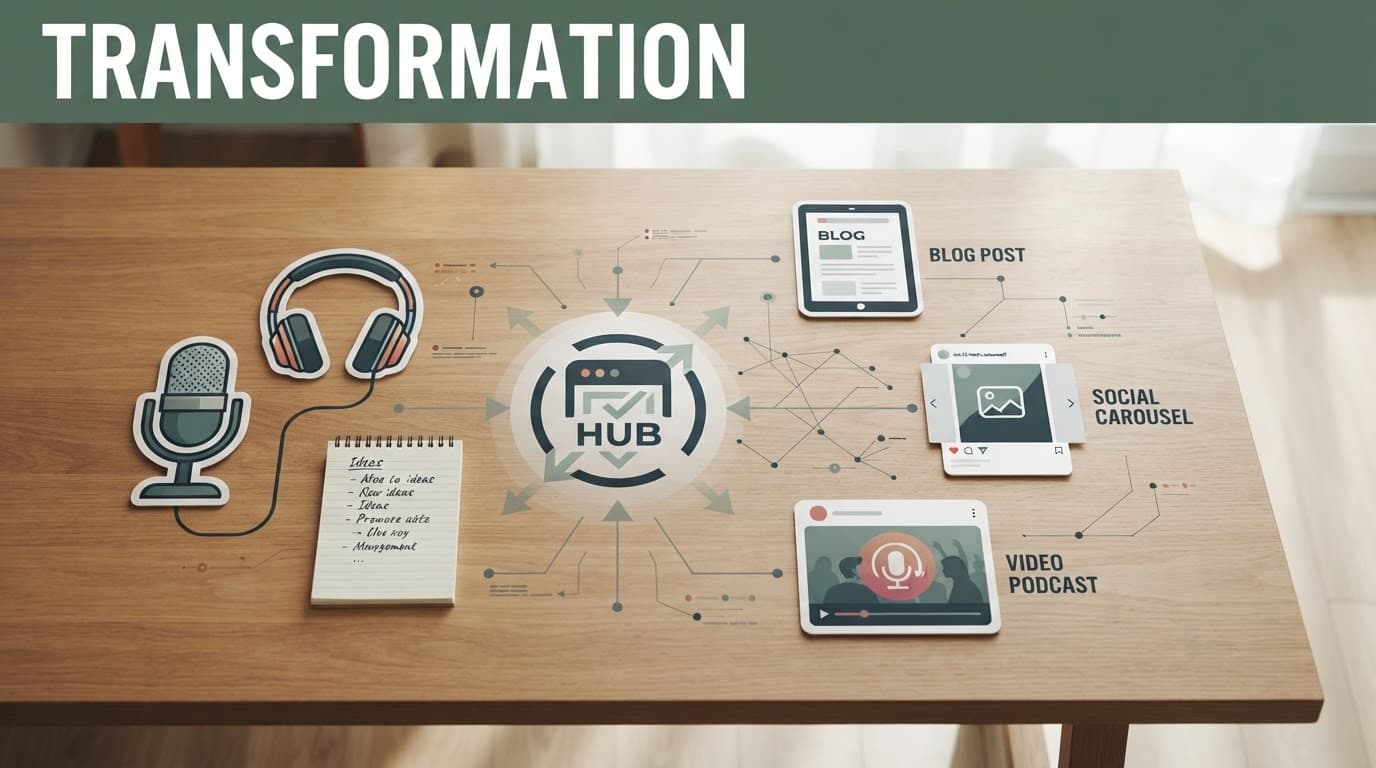
A 45-minute expert webinar is long-form content that can support several content assets without repeating its transcript. In AI content repurposing, the key is to separate the underlying information from the form that carries it.
The same channel-specific logic applies to podcast repurposing, and a webinar or episode about product onboarding could become:
A blog update that expands one overlooked onboarding problem, adds current data, and links to the full webinar.
A set of social media posts that extracts five practical decisions a manager can make during a customer's first week.
A newsletter that opens with a brief editor's note and features one lesson with a direct application.
A short-form video script built around one strong statement, one visual example, and a clear ending.
An FAQ that answers the recurring questions raised in the recording, with concise answers and links to deeper pages.
Each asset should use a different opening, structure, and amount of detail. A social post needs a clear single idea. An FAQ needs direct answers. A blog article needs context, internal links, evidence, and a reason to exist beside the original page.
For video, video clipping tools such as Descript, OpusClip, and Vizard can locate moments that work as vertical clips. These video clipping tools can surface clips and add automatic captions, but they cannot replace contextual review. A clipped statement may lose its qualifier or imply something the speaker didn't mean. Editors need to watch every excerpt in context.
For podcast repurposing, teams often use Castmagic or Podsqueeze for timestamps, show notes, summaries, and draft posts. These tools reduce transcription and formatting work. They cannot decide which claim deserves a citation, which anecdote is confidential, or whether an old recommendation remains accurate.
The best content repurposing software depends on where content creation slows down. Video teams may need video clipping tools and caption tools. Podcast teams often need podcast repurposing, transcription, and searchable notes. Editorial teams may need draft variants, approval records, publishing support, and workflow automation for connected systems.
Use content repurposing tools to compare options by the editorial bottleneck:
Workflow need | Useful tools | Human check |
|---|---|---|
Use video clipping tools | Descript, OpusClip, Vizard | Context, speaker intent, automatic captions |
Podcast repurposing | Castmagic, Podsqueeze | Facts, quotations, episode attribution |
Create carousels and visuals | Canva, Adobe Express | Claims, image rights, brand consistency |
Social media scheduling | Buffer, Hootsuite, Planable | Timing, comments, final approval |
Workflow automation | Zapier, Make.com, n8n | Duplicate triggers and publishing rules |
Prompt-based tools such as ChatGPT, Claude, and Gemini work best when editors give them structured inputs and a narrow assignment. “Turn this into five social media posts” invites generic output. A better brief names the source, platform, audience, claim, desired angle, proof points, prohibited language, and required attribution.
Costs vary by transcription minutes, video exports, team seats, social accounts, and approval controls. Basic solo plans often cost tens of dollars monthly, while agency plans rise with usage and collaboration needs. Compare total spend with content ROI, since unusable drafts require full rewrites.
Brand voice is not a list of adjectives. It appears in word choice, evidence standards, point of view, humor, sentence length, and the claims a company refuses to make. Teams should give AI a short style guide with approved examples, then edit the result against recent published work.
Accuracy checks matter even more when a source asset is old. Prices, laws, product features, and statistics can change after a webinar or article goes live. A reviewer should verify every claim that could affect a reader's decision, then add updated sources where needed.
Attribution belongs in the review process as well. Quotes, research findings, customer stories, and licensed visuals require clear credit and permission. AI cannot grant rights that the original publisher never had.
Before publication, compare the proposed page with existing site content. Hobo Web's duplicate-content guidance describes practical ways to find duplication, including searches for distinctive quoted phrases. Similarity tools can flag close wording, but an editor must decide whether near-duplicate pages compete for the same search intent and weaken organic search visibility.
When closely related pages must remain live, a canonical tag can identify the preferred URL. If one weaker page adds little value, merge its useful material into the stronger article and use a 301 redirect. A redirect is not appropriate when both pages answer clearly different questions.
AI-detection scores should not govern this process. They do not establish accuracy, permission, originality, or quality. Editorial review does.
AI content repurposing uses one source asset to create useful content for different audiences, channels, or formats. The facts can remain consistent, but each output should have a distinct editorial purpose.
Not necessarily. Repurposed content is different when it changes the audience question, structure, format, or reporting context instead of repeating substantially similar copy across multiple URLs.
AI can accelerate transcription, drafting, clipping, and formatting, but it cannot reliably verify context, current facts, permissions, or speaker intent. Editors should review claims and the complete asset before publication.
Start with a clear brief for each channel and compare every proposed page with existing site content. If two pages answer the same search intent, merge them, redirect the weaker page, or use a canonical tag where the related pages both need to remain live.
AI content repurposing earns its place when it extends useful reporting instead of multiplying interchangeable copy. The source remains visible, the facts remain intact, and each new content asset serves a distinct purpose on its channel.
The strongest safeguard is editorial judgment: a defined source of truth, meaningful format changes, human review, and careful publishing controls. Those habits protect search visibility while helping a content ecosystem give proven ideas a longer, more useful life across channels.