A grant proposal can read smoothly and still say something its research team never approved. That risk grows when an AI editor turns a cautious finding into a confident promise or replaces a precise method with a more familiar one.
The safest way to humanize AI grant proposals is to improve clarity and authentic voice while keeping the underlying project fixed. The grant writing process begins with a record of approved claims, then moves through small, checked edits rather than a single full-document rewrite.
AI-generated grant proposals often have a recognizable weakness: they describe worthy intentions without showing how the proposed work will happen. Phrases such as "advance understanding" or "create meaningful impact" can obscure the research question and objectives, the people involved, and the limits of the evidence.
A useful voice edit in grant writing makes an approved point easier to grasp. It may shorten a sentence, replace a vague phrase with an established project detail, or clarify which team member owns a task. It cannot add that detail unless the team has confirmed it.
Methods, preliminary data, qualifications, expected outcomes, and personnel commitments are research claims. So are eligibility statements, citations, dates, and budget figures. A rewrite that changes any of them needs a decision from the appropriate project owner, not an editor's judgment about what sounds persuasive.
This distinction matters most when the draft sounds plausible, especially during peer review. "The pilot suggests an association" and "The pilot demonstrates effectiveness" may occupy the same space on a page. They make different claims.
A fact lock is an approved record of what a proposal may say, tied to a source packet. It lets editors check revised sentences against evidence, not the earlier AI draft.
Build the source packet from the funding call and application guide, approved project aims and methods, current budget, and timeline. Add relevant source papers and confirmed bios or letters of commitment. Link these records to the grant application, and note the source of each consequential claim for grant writing. A file name and page reference are more useful than loose links.
Eligibility deserves its own entry. An AI-generated sentence saying an organization "qualifies" isn't evidence. The team must check the actual applicant, project, location, partnership, and deadline against the current funding opportunity and its eligibility criteria.
A fact lock shouldn't make unresolved choices look settled. If a collaborator hasn't agreed to a role or a data-access arrangement remains pending, mark that status plainly. Keep those passages out of the rewrite queue until an authorized person resolves them.
For community-led projects, this includes who set the research priorities and what authority community partners will have. A polished paragraph must not imply shared control when the documented arrangement is consultation. Uncertainty belongs in the record, even when it makes a sentence less tidy.
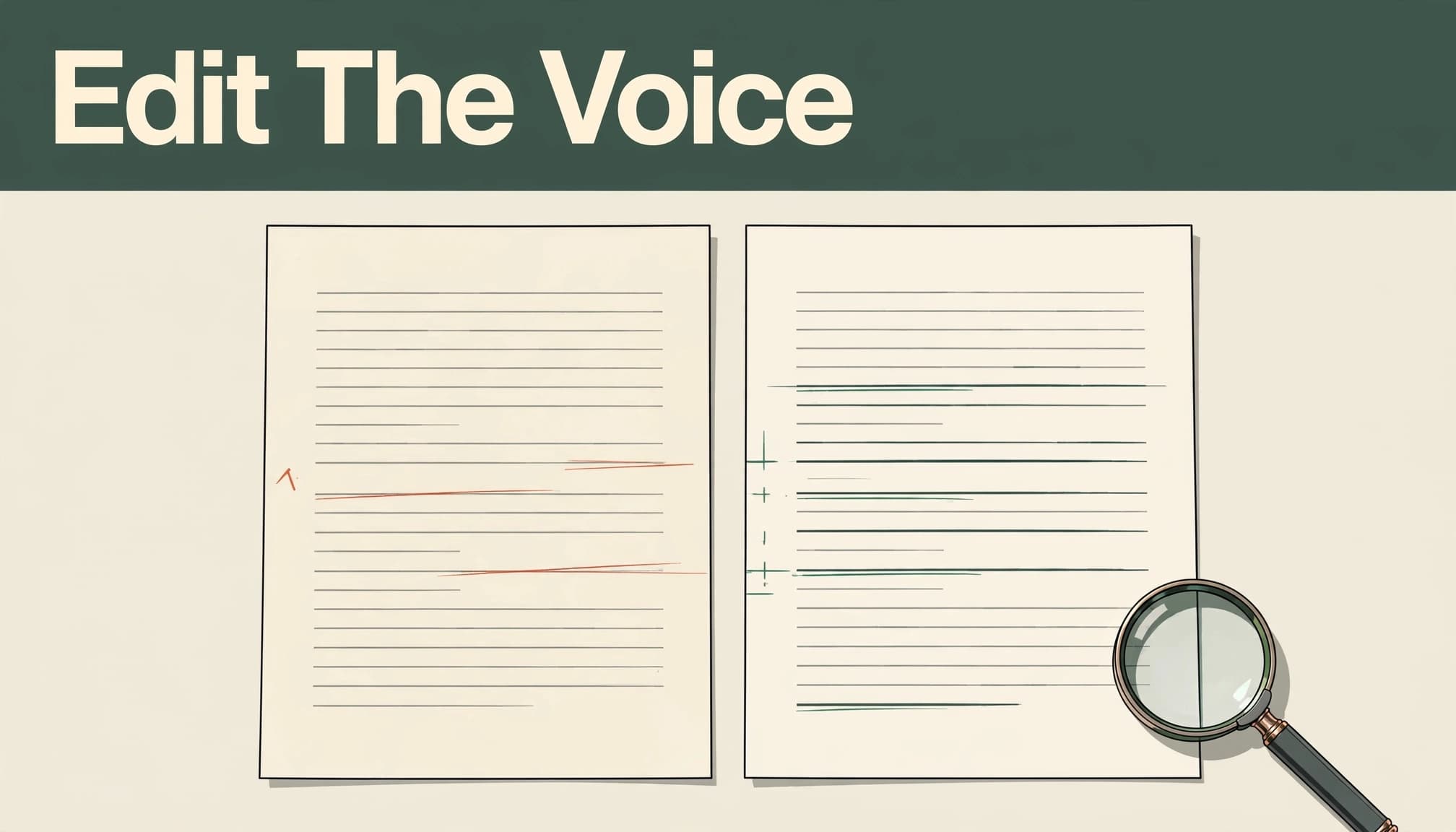
A whole-proposal rewrite makes changes hard to trace. Editing one paragraph at a time can humanize AI grant proposals while keeping the original, revision, and source packet close enough for meaningful comparison.
For grant writing, an editor can ask a general-purpose artificial intelligence (AI) tool to shorten sentences and remove repetition while preserving every technical term, number, citation, qualification, and statement of uncertainty. The instruction should also prohibit new evidence, altered methods, and stronger outcome claims. Unsupported additions should be flagged for human review rather than completed by guesswork.
For example, changing "In order to assess the feasibility of the approach, the team will conduct interviews" to "The team will conduct interviews to assess feasibility" improves flow. Replacing "assess feasibility" with "demonstrate effectiveness" changes the proposed work. The second edit requires project approval.
As part of proposal review, read the original and revised paragraph side by side. Check verbs such as "may," "will," "test," and "prove," then look for dropped negatives and conditions. Confirm that every citation still supports the sentence beside it.
These common edits need different treatment:
Proposed edit | Review decision | Reason |
|---|---|---|
Shorten a sentence without removing a condition | Usually a voice edit | The claim retains its scope. |
Replace "may improve" with "will improve" | Substantive change | The outcome becomes a promise. |
Replace a named method with a broader term | Check with the research lead | The new term may describe different work. |
A paragraph can sound more natural and still fail this check. Fluency isn't evidence that meaning survived.
In grant proposals, the research narrative can't be reviewed in isolation. Proposed activities must match what the application requests and what the approved budget can support.
Compare the narrative's staffing, travel, participant activities, equipment, and project timeline with the budget and budget justification. If a revised paragraph adds a workshop, additional recruitment, or a new analysis phase, it has created a funding decision. Removing an activity from the prose can be just as serious if the cost remains in the budget.
AI can organize budget notes or highlight differences between drafts. It shouldn't invent rates, assume a cost is allowable, or decide that a shortfall can be absorbed. Finance and project leads must confirm those points against institutional records and the funder's rules.
Reviewer guidance can sharpen grant writing without changing claims or overlooking funder priorities. The NSF merit review criteria, for instance, address intellectual merit and broader impacts. A revision may make an existing research question or documented outreach plan easier to find during peer review under those criteria.
That doesn't authorize adding an outreach commitment. Nor do the same criteria govern every application. NSF's Graduate Research Fellowship review process applies them to the completed fellowship application, while NSF SBIR merit review guidelines also address commercial potential. The specific funding opportunity's solicitation and application guide remain the test, including its eligibility criteria.
Teams may encounter purpose-built platforms for grant work, such as Grantable and Grant Assistant, alongside general-purpose AI tools such as ChatGPT. They may also use AI tools during a literature review. Those names alone say little about whether a tool suits a particular application.
An AI tool can help sort possible funding opportunities or summarize a call for discussion. Before anyone writes from that summary, a person needs to inspect the current funding notice. Eligibility, required attachments, page limits, deadlines, and review criteria come from the funder, not the summary.
The same boundary applies to a literature review. A proposed citation needs checking against the original publication. A fluent description of preliminary evidence is unsafe if the cited study measured a different population, endpoint, or period.
Before pasting a full proposal into a rewriting service, test it on an approved, non-sensitive paragraph. Compare how it handles terminology, qualifications, citations, and conditional language. A tool that repeatedly strengthens claims creates more review work than it saves.
Teams should check organizational compliance rules and funder policies before sharing unpublished results, participant information, or confidential partner material. They should also review data security requirements before uploading underlying data to an outside service. Humanizing should improve the document's readability, never conceal how it was produced.
Grant writing requires an accountable owner for a proposal’s science and final wording. Saved drafts make that responsibility easier to exercise.
Keep the approved source packet, original text, AI-assisted revision, and final tracked changes together. Assign research claims to the principal investigator or project lead, costs to the budget owner, and application requirements to the person preparing the submission.
If an editor flags an unsupported sentence, leave it flagged until its owner supplies a source or removes it. Don't let a later polish pass smooth away the warning. This matters especially when several people work on different sections near a deadline.
Before using artificial intelligence to humanize AI grant proposals, check the funding opportunity, application guide, and institutional policy. Where rules differ, follow the instruction governing that grant application. If disclosure is required, name the tool, describe what it did, identify affected sections, and state who verified the result.
Detector scores don't settle whether a claim is accurate or whether a use was permitted. AIHumanizer's discussion of GPTZero false positives for non-native writers illustrates why draft history is more useful than a score during proposal review. The purpose of editing is a faithful proposal, not detection evasion.
Before submission, conduct a final proposal review with the fact lock, source packet, and funder's instructions open:
Confirm that aims, methods, study population, preliminary findings, and expected outcomes match approved records.
Check names, roles, qualifications, partner commitments, dates, numbers, and every quoted or cited claim.
Compare activities and timing with the budget, budget justification, and project timeline.
Verify eligibility, attachments, formatting, and any criteria unique to the funding opportunity.
Review changed verbs, negations, conditions, and technical terms against the original text.
Record the necessary approvals and follow the applicable AI-use and disclosure requirements.
Review the final assembled grant application, not only the narrative paragraphs. A correct sentence can still conflict with another section or an attachment.
Teams can humanize AI grant proposals by treating voice as an editorial task and research claims as controlled decisions. A source packet establishes what grant writing may say; paragraph-level comparisons catch changes polished prose can hide.
The final standard is traceability. Each consequential statement should lead back to an approved source or a named person who authorized it.
In grant writing, a voice edit changes how an approved claim is expressed while preserving its meaning and limits. Shortening a sentence or removing repetition can qualify. Changing "plans to test" to "will demonstrate," adding a participant group, or implying a result the data don't support changes the proposal's substance.
AI tools can help organize approved figures or compare a narrative with a budget draft. The team must still verify rates, quantities, allowability, arithmetic, and the budget justification. A plausible number supplied by a tool has no authority simply because it fits neatly into the application.
The funder's application guide and institutional rules determine what a grant application must disclose. When disclosure is called for, a concrete description of the tool, task, affected sections, and human verification is more informative than a vague statement that AI "helped." The applicant remains responsible for the submitted claims.
The most dangerous way to humanize AI grant proposals isn't an awkward rewrite. It's an elegant sentence that changes what the project can support.
A fact lock, small edits, and named approvals keep grant writing clear without letting style decisions settle scientific or financial questions. Authentic voice comes from describing the actual project in the grant application faithfully, including its limits.
