
How to Preserve Numbers and Units in AI Rewrites
A rewrite can sound clearer while making a result less true. A temperature of 98.6 °F can become 99 °F, a price of $1.25 million can become "$1 million," and a range of 4.5-6.0 mg/L can lose the upper bound without any warning.
To preserve numbers and units, writers and editors must treat values, signs, decimal places, formulas, citations, and unit symbols as meaning-critical content. Better prose is useful only when the underlying record remains intact.
Key Takeaways
Every numeral, unit, date, percentage, formula, and currency figure needs a verification pass after an AI rewrite.
Prompts should tell the model to retain values exactly, including punctuation, minus signs, exponents, and unit symbols.
SI formatting follows its own conventions, while APA, IEEE, and Chicago style guides make different decisions about numerals in prose.
A polished paraphrase can still round, convert, omit, or broaden a factual claim.
In Adobe InDesign, "Preserve Numbers" refers to CMYK color values, not manuscript data. Both forms of preservation require source-to-output comparison.
What "Preserve" Means in an AI Rewrite
A value carries more than its visible digits. It includes precision, direction, scale, unit, context, and sometimes legal or scientific consequences. Changing 0.05 to 0.5 is an obvious error. Changing "up to 5%" to "5%" is subtler, but it also changes the claim.
Preserve the full expression, not only the numeral
A safe rewrite keeps every meaningful part of the source expression, including number ranges and qualifiers:
Source expression | Unsafe rewrite | Preserved form |
|---|---|---|
21.0 °C | 21 °C | 21.0 °C |
98.6 °F | 37 °C | 98.6 °F |
$4.75 per unit | about $5 each | $4.75 per unit |
12%-15% | 12 to 15 percent | 12%-15% |
6.02 × 10^23 mol^-1 | 602 sextillion per mole | 6.02 × 10^23 mol^-1 |
The right-hand column retains the original level of precision and notation. A conversion may be mathematically possible, yet it isn't a faithful rewrite unless the task explicitly authorizes conversion and the result is independently checked.
A rewritten sentence can preserve its general idea while corrupting the evidence that supports it.
Keep data separate from stylistic change
Sentence order, transitions, and word choice can change. A model should not alter values, units, equations, citations, product codes, dates, figure labels, or quoted language unless an editor has asked it to do so.
This distinction matters in research papers and technical documentation. A rewritten finding that changes "a 3.2% increase" to "a modest increase" loses the result. Similarly, moving a citation marker can leave a claim attached to evidence that doesn't support it.
How to Preserve Numbers and Units in AI Rewrites
The strongest workflow uses narrow instructions, limited rewrite batches, and a comparison against the source. This process is especially important in academic writing. AI systems predict plausible language. They don't independently verify a calculation, an exchange rate, a dose, or a reported result.
Mark protected content before rewriting
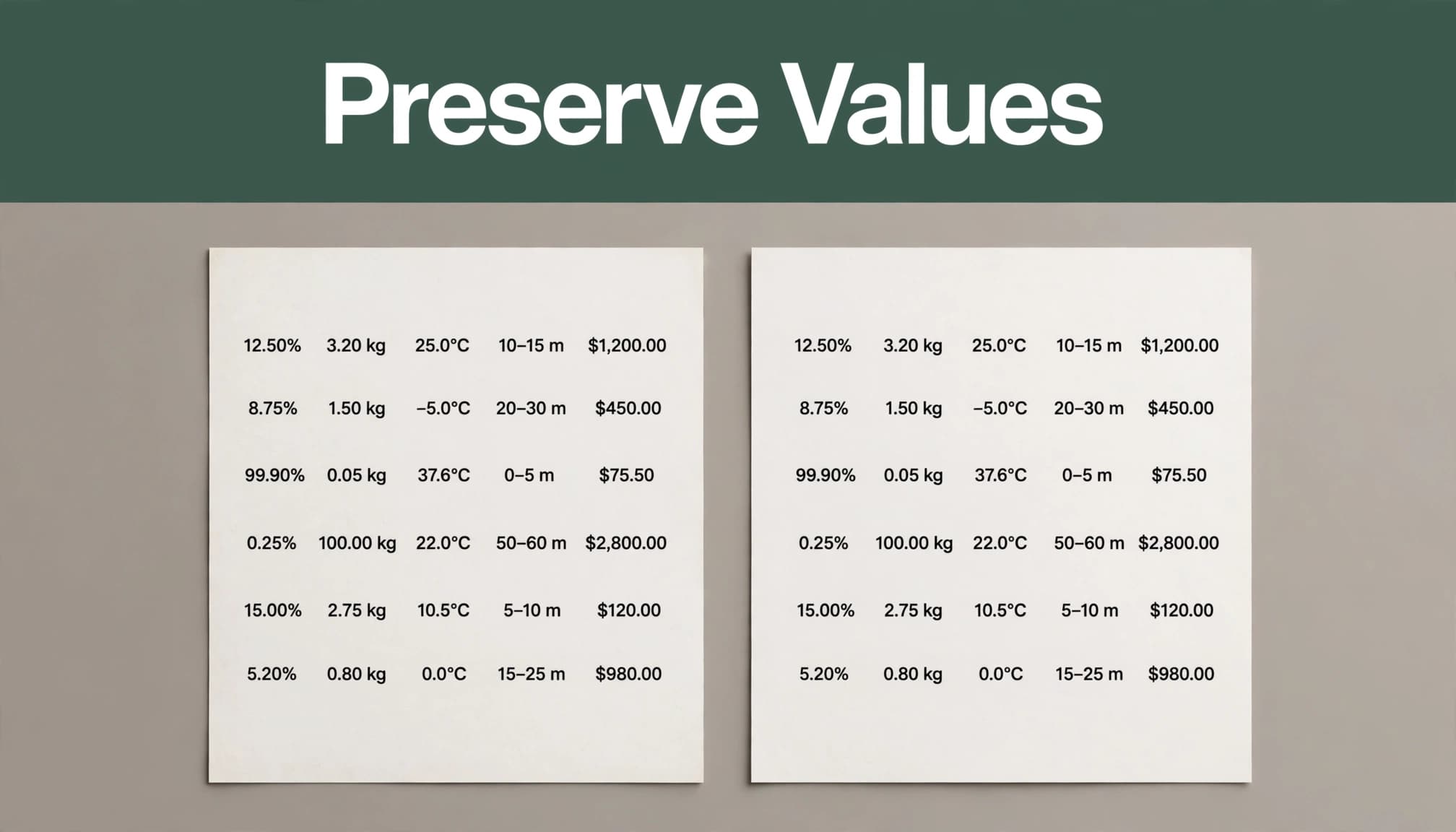
Before submitting text, identify every item that must remain unchanged. This includes:
Numbers, decimal places, negative signs, percentages, and currency values.
Dates, times, ranges, version numbers, and page references.
Units, scientific notation, formulas, chemical names, and statistical symbols.
Citations, URLs, quoted wording, and figure or table callouts.
For a long document, copy these items into a separate reference list. This makes omissions visible. It also prevents an editor from relying on memory after a model has changed surrounding phrasing.
Use restrictive instructions, not broad requests
"Make this sound natural" leaves too much room for interpretation. A more reliable prompt states the limits plainly:
Rewrite for clarity and flow. Preserve every number, decimal place, sign, percentage, currency value, date, formula, range, citation, and unit exactly as written. Do not round, convert, expand, omit, reinterpret, or move data. Flag any sentence that cannot be rewritten without changing its meaning.
The instruction should also state whether numeric formatting may change. Any permitted change must follow the publication's style guides. For example, an editor may permit "five participants" instead of "5 participants" in narrative prose. That change is acceptable only when it doesn't affect a measurement, result, date, currency value, formula, or other protected expression.
Work in short sections when the source contains dense data. Long rewrites make it harder to locate a missing minus sign or a shifted exponent.
Compare source and output line by line
Comparison is the control step, not an optional polish. Editors should search both versions for numerals, %, $, °, ×, minus signs, parentheses, and citation markers. A spreadsheet, document comparison tool, or regular-expression search can accelerate the task, but visual review still matters.
Retaining the source draft and revision history also protects the editorial record. For writers facing automated scrutiny, documenting the writing process for AI reviews can be more useful than treating a detector score as proof of authorship.
Apply SI Rules Before Finalizing Technical Copy
Technical writing must preserve the value and its conventional presentation. The International System of Units has standard practices that a paraphrasing model may flatten or apply inconsistently. Technical copy should follow the international system of units when presenting measurements.
Keep a space between the value and unit symbol
NIST states that a unit symbol follows the numerical value, separated by a space. Therefore, technical copy uses forms such as 5 kg, 23 m, 15 s, and 20 °C. The same care applies to measurement units embedded in compound descriptions, such as a 10 m cable.
NIST's rules for expressing SI values provide the governing convention for expressing SI units in the metric system. A rewrite should not compress 12 mL into 12mL, replace it with "twelve milliliters" without editorial approval, or silently change mL to L. After numerical meaning is protected, relevant style guides may determine the final presentation.
Protect symbol case and scientific notation
Unit symbols are case-sensitive. m means meter, while mm means millimeter. NIST notes that symbols generally use lowercase letters, with L for liter as a familiar exception. The case of these unit symbols can change the quantity itself, so it isn't decorative.
Scientific notation deserves the same protection. The values 3.0 × 10^-6, 3 × 10^-6, and 3.00 × 10^-6 may indicate different levels of reported precision. Keep multiplication signs, powers, superscripts, and trailing zeros as supplied unless the governing style guide instructs otherwise.
Match the Required Academic Style Guide
The familiar rule to spell out numbers below ten is only a starting point. Academic writing depends on field-specific style guides, while technical conventions often govern SI units.
APA and IEEE favor numerals with measurements
APA style generally spells out numbers below 10 in ordinary prose and uses numerals for 10 and above. However, APA uses numerals with units of measurement and in statistical or mathematical functions. The APA formatting checklist makes this exception explicit. Check these rules against the publication's style guides.
IEEE style sets a similar but not identical threshold. Its editorial manual says writers should always use numerals with units, while numbers below 11 are usually spelled out in non-measurement prose. The IEEE Editorial Style Manual is the better authority for engineering manuscripts than a generic rewriting preference. IEEE style may differ from conventions used in other academic fields.
Vancouver style may impose its own numeral and reference conventions, depending on the publication. Check the journal's specific instructions before changing numbers or citation details.
Chicago style requires editorial judgment on ranges
Chicago style also uses numerals with measurements such as kg, cm, and °C. Chicago style's broader number rules differ by context, including prose, tables, dates, and number ranges. A range like 104-108 shouldn't be casually restyled as 104 to 108 if the publication has a defined range convention.
The safe approach is to preserve the original range structure during the AI pass, then apply the publication's house style under Chicago style during copyediting. Editors should also apply Vancouver style only after preserving the source expression. Review the final text against the relevant style guides. AI should never decide that a range is approximate, inclusive, exclusive, or convertible.
Protect Specialized Terms, Formulas, and Citations
Scientific language often pairs ordinary words with controlled terminology. Replacing a term with a near-synonym can damage indexing, reproducibility, or disciplinary accuracy.
Leave chemical nomenclature intact
Chemical formulas and compound names should be treated as protected strings. H2SO4, NaCl, and Fe3+ cannot be rewritten for variety. Likewise, a systematic compound name should remain unchanged unless a qualified chemist or approved nomenclature reference directs a correction.
IUPAC nomenclature recommendations exist to keep terminology unambiguous across scientific fields. An AI rewrite may improve the sentence around a chemical term, but it shouldn't improvise a new name or expand an abbreviation without authority.
Preserve gene symbols and source markers
Gene nomenclature follows organism- and journal-specific rules. Gene and protein symbols also require accurate capitalization, italics, and formatting. Follow the relevant database, journal style guides, journal instructions, or laboratory reference rather than an AI's guess.
Citations need comparable protection. Check every parenthetical citation, superscript, page locator, and reference number against the source. A citation that remains visible can still become misleading when a rewrite strengthens the claim beside it.
Prevent Color Conversion in Adobe InDesign
The phrase "preserve numbers" has a second meaning in print production and color management. In Adobe InDesign, it concerns CMYK channel values during PDF export, not figures in a manuscript.

Check profiles before changing export settings
Unexpected color conversion often begins with a mismatch between document profiles and the destination profile. Legacy files can contain values intended for a particular printing condition. Changing profiles without inspection can alter the numerical CMYK build even when the color appears similar on screen.
Before an InDesign export, verify the document color settings, the assigned CMYK profile, the printer's requested cmyk profiles, and the status of placed artwork. A prepress workflow should retain a source PDF or packaged InDesign file for comparison with legacy files.
Understand "Convert to Destination (Preserve Numbers)"
Adobe explains that "Convert to Destination" converts all colors to the chosen destination profile. "Convert to Destination (Preserve Numbers)" converts colors only when their profiles differ, according to Adobe's PDF export options.
That setting isn't a universal promise that every legacy CMYK value will survive untouched. The result depends on profile relationships, object types, and the chosen destination. In this pdf workflow, inspect the exported PDF with Acrobat Pro, then use Acrobat Pro's preflight or output-inspection tools alongside the printer's preflight process. Compare sampled CMYK values to the source before release.
Frequently Asked Questions
Can AI safely convert °C to °F or convert currencies?
Only when the assignment explicitly requests conversion and a human verifies the calculation, rounding rule, date basis, and destination format. A temperature conversion may change the intended precision, while a currency conversion requires a stated exchange-rate date. In most rewriting work, 18.0 °C, 64.4 °F, and EUR 250 should remain exactly as supplied.
Should an editor accept a paraphrase if the main number remains?
No. A value without its unit, qualifier, range, or uncertainty can become false. A number range must be checked as a complete expression, not judged by its main value alone. "Less than 0.1%" is not equivalent to "0.1%." "Between $8,000 and $10,000" is not the same as "$10,000." Editors should compare the full expression, then read the revised sentence to confirm that it still makes the same claim.
Can an AI detector confirm that a technical rewrite is trustworthy?
No. Detector scores assess patterns in language, not the accuracy of a measurement or the integrity of a citation. Scientific and legal writing often repeats exact terms because precision requires it. Techniques for refining AI-assisted writing can improve readability, but factual review remains a separate editorial responsibility.
Preserve the Record, Then Improve the Prose
The safest rewrite changes language around the data, never the data itself. Exact values, units, ranges, formulas, and citations should survive every stage, from prompt to copyedit to final export.
Fluent text can conceal a rounded number or a converted CMYK value. Comparison against the original is what turns an AI rewrite into an accountable editorial revision.