
How to Humanize AI Podcast Scripts for Natural Delivery
A podcast script can be grammatically flawless and still sound awkward at the microphone. The first step to making AI-generated scripts sound more natural is to test whether a listener can follow each thought on a single hearing. AI-generated text often packs too much into one sentence or gives every host the same polished voice.
The useful edit protects the host's point of view while making it easier for the target audience to follow. That work begins with the material behind the draft.
Key Takeaways
Give an AI draft the host's approved notes, sources, and speaking samples before asking it to write.
Revise the order of ideas before polishing sentences. Then read the script aloud and mark every place the voice strains.
Compare rewrites with the source. A smoother line isn't an improvement if it changes a fact, a qualification, or the host's meaning.
Why a clean AI draft can sound wrong on air
An article lets readers stop, reread, and inspect a difficult sentence. A podcast rarely offers that pause. When a script introduces a source, a statistic, and a qualification in one breath, the listener may miss the point before the host reaches the verb.
NPR Training's guide to print and radio storytelling makes the distinction clear: radio needs shorter sentences, and information must arrive more gradually. AI-generated text can miss both requirements while sounding polished on the page.
The other problem is uniformity. An opening can promise an "in-depth exploration," followed by robotic phrasing that announces every turn. Those phrases add time without giving the listener a place, a person, or a reason to care. Removing them leaves room for the host's actual observation.
How to humanize AI scripts around the host's voice
The host's voice is more than a preference for casual words. It includes what they notice, how they handle uncertainty, and when they let an idea stand without explaining it twice.
Start with material the host can stand behind
A useful draft brief contains the episode's central claim, approved research, interview notes, and any limits on what can be said. It also identifies firsthand observations the host has approved for broadcast. Without that material, a model may fill a gap with a plausible anecdote that never happened.
An AI humanizer or text converter can't supply firsthand details or know what the host can truthfully stand behind. A short source packet works better than asking a tool to "sound authentic." Guidance on firsthand evidence in AI-assisted writing makes the same editorial point: retain the real details and check claims against their source material.
Study spoken choices, not verbal decoration
A producer can transcribe a few minutes of the host's unscripted speech. The host's writing style shows in choices, not filler words or an exaggerated accent. Does the host state the finding first? Do they explain a technical term with an example? Where do they allow themselves to be uncertain?
NPR's account of Sam Sanders finding his radio voice connects writing in one's own voice with simpler sentences that the ear can follow. A voice reference should help the editor retain the host's custom voice and conversational tone, not imitate an accent or add filler.
Give each spoken idea its own place
To humanize AI scripts, editors often need to change the structure before the wording. One sentence may contain several accurate facts but still ask too much of a listener.
Untangle sentences without thinning the argument
According to NPR Training's radio-writing essentials, spoken syntax is simpler than written syntax. A practical edit uses clear sentence structure: put the main point near the start, move context after it, and cut dependent clauses that interrupt the thought.
Shorter doesn't mean every line must sound clipped; use natural language the host can say comfortably. A longer sentence can carry a familiar idea. The sentence introducing a new name, term, or distinction needs more space around it.
Make transitions carry information
"Furthermore" and "moving on" often announce a shift without explaining it. A useful transition tells listeners why the next idea follows. If an episode moves from a product claim to a test result, the host might say, "The recording tells a different story." That line sets up evidence and establishes a point of view.
A script also needs clear attribution. Put the source close to the claim it supports, especially when a host moves between reported findings and personal judgment.
Before and after: two edits that change the sound
The strongest revisions remove work the listener shouldn't have to do. These examples keep the underlying point while changing how it reaches the ear.
Turn a written summary into a spoken thought
Before: "According to guidance provided by NPR Training, the transition from print to radio storytelling necessitates shorter sentence structures and a more gradual presentation of information."
After: "NPR Training recommends shorter sentences for radio. Give listeners time to take in one idea before the next arrives."
Both versions attribute the advice. The second gives the host two manageable breaths and puts the action where a listener can hear it.
Keep a necessary qualification
Before: "AI rewriting tools preserve the meaning of a script while making every line sound natural."
After: "A rewriting tool may smooth a line. The producer still has to check whether the meaning survived."
The first version makes a promise no editor should assume. The revision preserves the useful possibility while naming the review it requires. It also sounds like something a host could say without suddenly adopting the language of marketing copy.
These edits don't depend on adding slang or inserting pauses at random. They preserve the original meaning while making the claim clearer, so natural emphasis has somewhere to land.
Test the script at the microphone
A screen edit catches repetition. A read-aloud edit catches the places a mouth, an ear, or a conversation can't keep up.
Mark the strain, then revise the cause
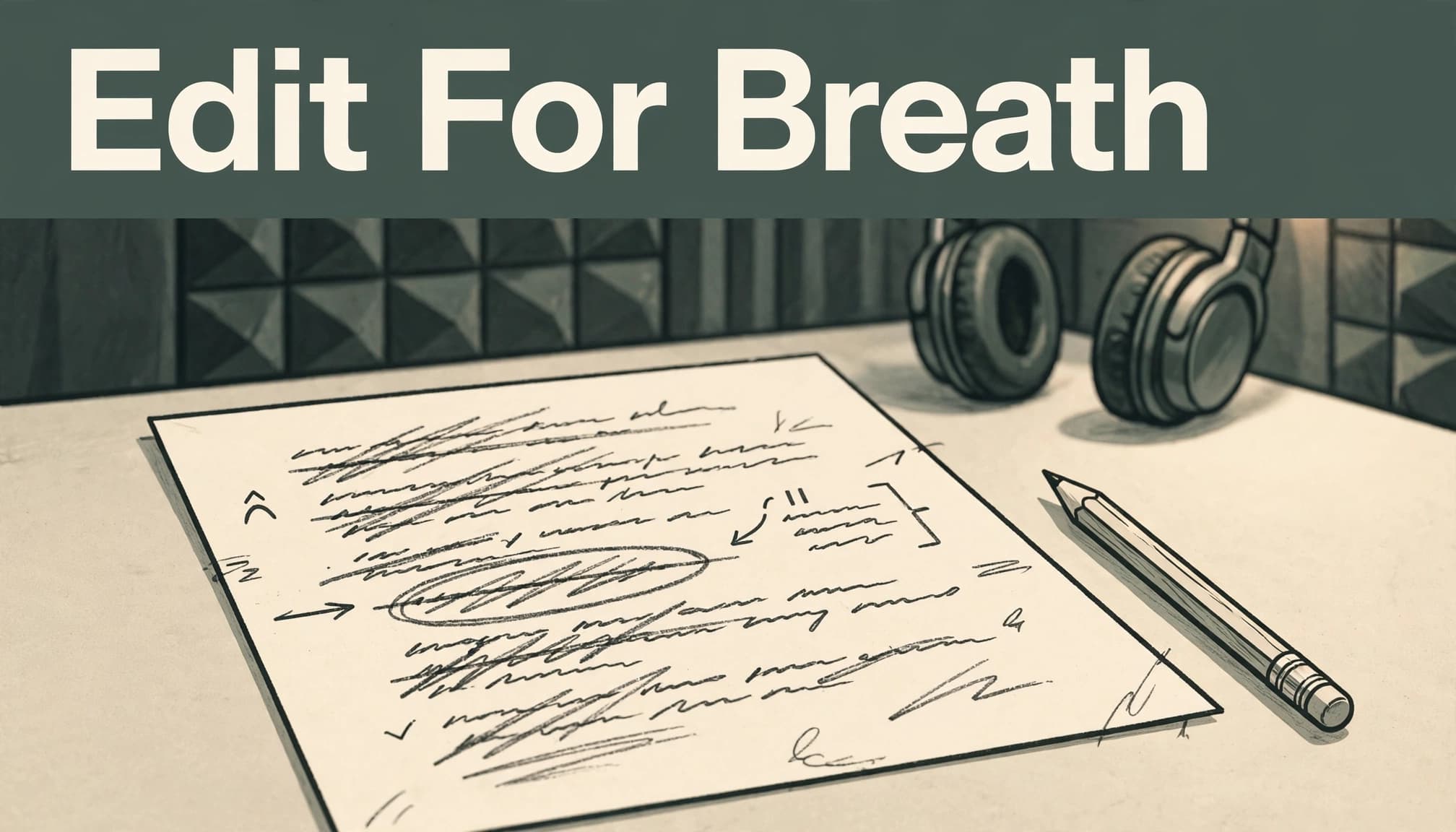
Read at the host's normal pace and mark each stumble, unplanned breath, and phrase that needs a second attempt. If a text converter suggests a line, test it at that same pace. Don't solve every mark with a slash for a pause. Move the source name, split a clause, or replace a difficult sequence of words.
Recording a rough pass helps because the editor can listen without looking at the page. Practical guidance on improving writing through revision is useful here, but the microphone supplies the final test: the sentence has to work in this host's voice.
Check both sides of a conversation
For an interview episode, read the host's questions in sequence. Repeated openings and overlong setups become easier to spot when the guest's answers are temporarily removed. Then restore the exchange. A question that looks elegant alone may repeat something the guest has already said.
Pauses and interruptions should have a reason. An unscripted reaction may carry more life than a written "Wow," provided the edit leaves the guest's meaning intact.
Use rewriting tools for narrow editing jobs
An AI humanizer or paraphrasing tool can offer alternate wording. A text converter can reshape a sentence, while Grammarly catches grammar issues and suggests a tone adjustment. Artificial intelligence can support content creation, but fluent output isn't automatically human output or a fit for a host's custom voice in the booth.
Give the tool constraints it can follow
A narrow request gives an editor revisions to compare: "Shorten these sentences for speech. Keep every name, number, citation, and qualification. Don't add personal experience." An AI humanizer's suggestions are drafts for editorial review, not a substitute for the host's choice. Use a paraphrasing tool on short passages rather than sending an entire episode through a rewrite at once.
The original script remains the reference. If the tool replaces a technical term, changes the certainty of a claim, or moves attribution away from a finding, restore the accurate wording.
Let the host make the final choice
Automated suggestions are useful for spotting repeated openings or producing two ways to say a difficult sentence. They can't decide whether a joke fits the host's judgment, or whether a careful silence belongs after an interview answer.
A producer can compare alternatives on the page. The host can settle a close choice by speaking both versions. Natural delivery is a performance test, not a readability score.
Protect accuracy and editorial responsibility
A script can become more fluent as it becomes less reliable. That risk grows when a rewrite compresses research or turns a cautious finding into a broad claim. In research-based work, that can also threaten academic integrity.
Audit facts after the language edit
Check names, dates, numbers, quotations, and source attribution against the approved material, and keep qualifications attached to their claims. A plagiarism check may flag copied wording, but it can't verify facts, attribution, or invented experience. If a host says, "In this test," an edit must not turn the result into a universal rule.
For collaborative episodes, save the original draft and the revised script. A producer can then trace a changed line back to its source rather than relying on memory during recording.
Keep detection separate from quality
AI detection tools estimate patterns in text; they don't establish who wrote a script or whether it will sound good aloud. A 2025 study of AI-output detectors found that false positives remain a concern, even where tools can distinguish some generated text. The site's discussion of GPTZero false positives for non-native writers also explains why keeping drafts and notes matters.
Disclosure depends on a show's policies, contributor agreements, and the context of the work. Editorial responsibility doesn't. The people publishing an episode remain accountable for its claims and its portrayal of guests.
A repeatable editing checklist before recording
Confirm the episode's main claim against the host's notes and approved sources.
Cut sections that repeat a point or arrive before the listener has enough context.
Put one new idea in each sentence where names, figures, or technical terms appear.
Replace generic transitions with connections that explain the next turn.
Compare every rewritten claim, quotation, and qualification with the original material.
Read the host's lines aloud, then listen to a rough recording without the script in view.
Review interview questions alongside the guest's answers and make the final changes in the host's voice.
Frequently Asked Questions
Can a humanizer make a podcast script sound like a particular host?
An AI humanizer or text converter can suggest different wording, but approved samples and clear constraints make either more useful. The producer and host must decide which choices match the speaker's habits, judgment, and relationship with the audience.
Should spoken scripts include contractions and filler words?
Contractions often fit ordinary speech. Filler words rarely improve a line when added by hand. The better test is whether the host would naturally use the phrase while explaining the idea to someone else.
Does humanizing a script help it bypass AI detection?
A rewrite can change a result from AI detection tools, but that doesn't prove it can bypass AI detection. No score establishes authorship or spoken quality. Editing should focus on accuracy and delivery, not on manipulating a classifier.
Is using AI to draft a podcast script plagiarism?
AI assistance alone doesn't settle that question. A script can still misuse a source, reproduce someone else's words without credit, or present an invented experience as the host's own. Source checking, attribution, and the show's disclosure rules govern the final episode.
Conclusion
A polished page is only a starting point. The listener's first hearing is the real constraint: each claim needs room to arrive, and each line needs to belong to the person saying it.
The edits that matter most preserve evidence and the host's judgment. Once those are secure, a script can sound natural without pretending it was improvised.