
Editing AI Literature Reviews Without Inventing Consensus
Artificial intelligence can help polish a literature review, but polished wording can make disagreement disappear without changing a single citation. AI may turn a limited finding into a general conclusion, or place conflicting studies beneath a sentence claiming that researchers agree. The danger when editing literature reviews with AI is that fluent prose can conceal a broken link between a claim and its evidence.
A sound revision begins with the original papers, not the wording of the draft. Each substantive claim must survive a source check before it earns a place in the final synthesis.
Set the review's rules before editing its prose
Identify the kind of review
A narrative review, whether for a dissertation or journal article, may organize selected scholarship around an argument. A scoping review maps the extent and characteristics of work on a defined question. A systematic review follows a prespecified method for searching, selecting, appraising, and synthesizing studies. The editing standard must match the method.
For a systematic review, an AI-generated paragraph can't repair an undocumented search or an inconsistent screening decision. Oregon Health & Science University's guidance on AI in systematic reviews cautions against letting generative AI independently perform core methodological work. Editors need the protocol, eligibility criteria, search record, and included studies alongside the draft.
Separate assistance from authority
A tool can serve as a bounded research assistant, helping sort records, extract candidate details, or propose groupings. Those outputs are working material. They don't establish what a study found or whether a field agrees.
The research workflow should follow the method and eligibility rules. Before revising a sentence, the researcher should know which papers are eligible and what question each section answers. Otherwise, an editor may make the prose coherent by joining studies that investigated different populations, outcomes, or periods.
Editing AI literature reviews at the claim level
Inspect the strongest claims first
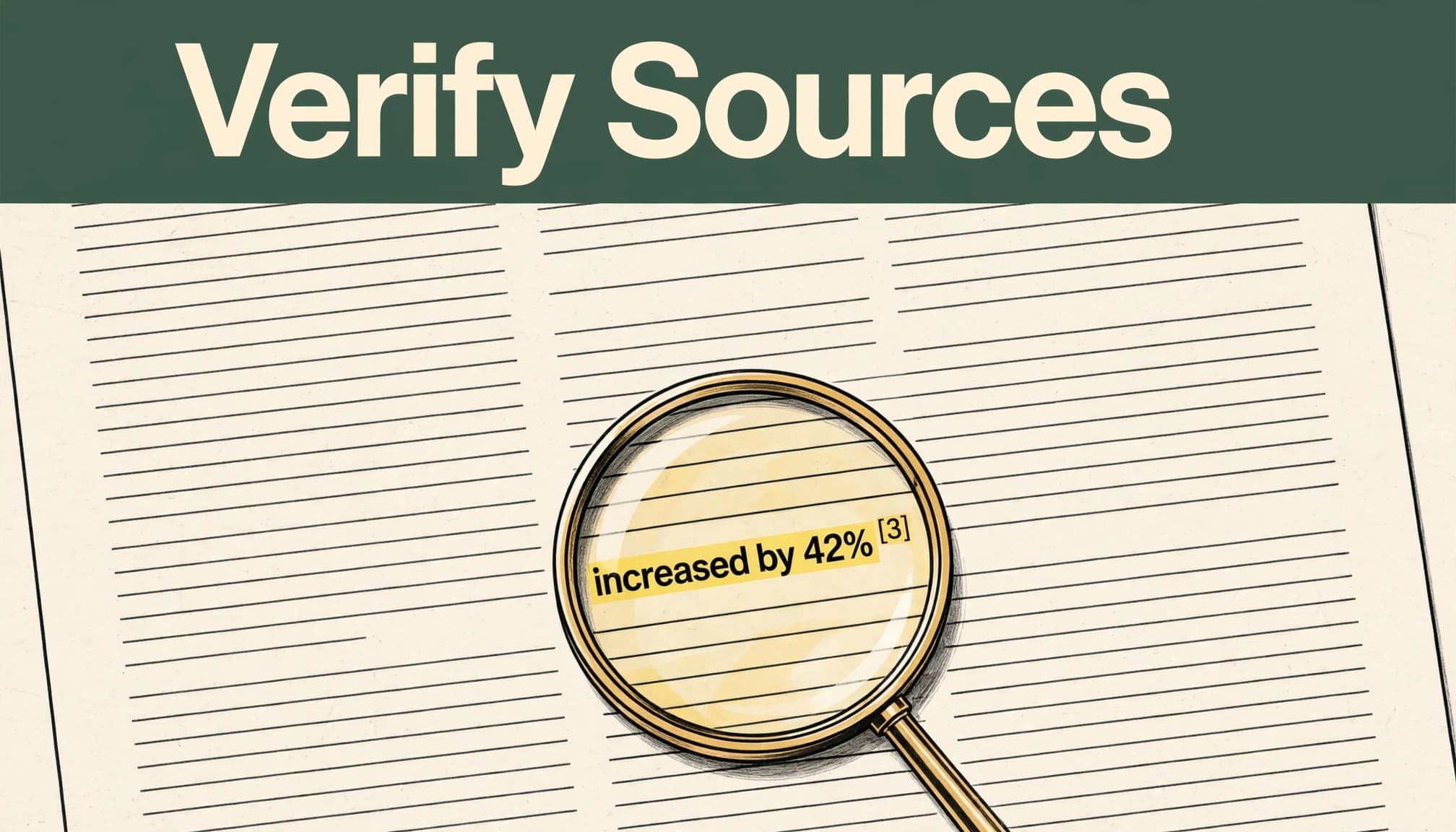
Fluent wording from generative AI can make a claim sound stronger than the evidence. Words such as "caused," "proved," and "eliminated" deserve immediate scrutiny because they may turn an observed association into a causal finding. "All patients" may replace a narrower study population; "long-term benefit" may appear beside a short follow-up.
Use critical thinking in the first editing pass to mark claims about effects, prevalence, agreement, and research gaps. Also flag numbers and quotations. For each, the original article or dataset must support the exact proposition in the revised sentence, including its qualifiers.
A citation beside a claim is only a pointer. It isn't proof that the cited authors measured the stated outcome or reached the stated conclusion. Hallucinations can also produce invented or mismatched citations.
Read the methods and results, not only the abstract
Abstracts compress findings and often leave out exclusions or qualifications. Check academic sources in full, including peer-reviewed research. The methods and results show who participated, what comparison authors made, how they measured the outcome, and what limitations they reported.
The sequence is simple: locate the cited work, read the relevant methods and results, then revise the sentence to fit. If a source cannot be found, remove the claim or replace it with one supported by a source that has been read. Asking another model to supply a plausible citation only compounds the problem.
Keep every citation attached to the claim it supports
Check the reference and the sentence together
Citation review has two parts. First, confirm that the reference exists: authors, title, publication details, date, and DOI or stable link. Then ask whether that work supports the adjacent wording.
An AI rewrite may preserve an author-date marker while changing "was associated with" to "improved." It may also move a citation to the end of a paragraph, where the marker appears to support several claims instead of one. Numbered references, page locators, and grouped citations need the same side-by-side check against the pre-AI draft.
Maintain a claim-to-source record
A compact evidence table makes later revisions easier to defend. Each row can contain a draft claim, its supporting research papers, the relevant page or table, the study population and design, and the editorial decision: retain, narrow, qualify, or delete.
This record matters when several papers support one sentence. It shows whether they address the same outcome and whether one paper contradicts the others. Citation analysis can help trace relationships and locate sources, but it can't replace checking whether each source supports its claim. For protocol-driven reviews, the record also helps distinguish a verified extraction from an AI-suggested one. A smooth paragraph offers no substitute for that trail.
Synthesize across studies without erasing disagreement
Replace serial summaries with comparisons
A review that gives each paper its own sentence may accurately describe the papers yet say little about the scholarly literature as a whole. Thematic synthesis compares studies under a shared question. It identifies where designs and findings align, then explains differences that matter.
An extraction matrix can compare research papers by population, method, outcome, follow-up period, and result. Researchers can use it to draft a paragraph that distinguishes an association reported in observational work from an effect tested in an intervention. AI may suggest the grouping, but the included studies must determine it.
Give conflicting results their proper scope
Disagreement is sometimes a finding. Two papers may appear to conflict because one examines a different population or uses a different outcome measure. They may also reach opposing results under comparable conditions. The prose should say which situation applies.
A useful edit replaces "studies show" with a bounded account: which studies, which methods, and which results. Where evidence is mixed, the review should preserve that uncertainty rather than average it away in a confident opening sentence.
Agreement among summaries is not evidence of agreement among studies. The original papers must support the same claim under comparable conditions.
Use research tools for bounded tasks
Discovery is not a documented search
AI tools such as Elicit can help researchers explore papers and organize extracted information. Semantic Scholar supports discovery, while Research Rabbit helps visualize citation connections. SciSpace can assist with reading a paper, while Consensus frames searches around research questions. Used as a bounded research assistant, generative AI can surface material worth examining, but it can't establish a complete or unbiased body of evidence.
A citation network supports citation analysis and helps find connected papers, but its structure depends on what enters the network. It doesn't show every eligible study, so check results surfaced through Semantic Scholar against the review's criteria. Systematic work needs a reproducible search and selection record. King's College London's guide to AI in evidence synthesis is a useful reference for placing tools within that process.
Treat automated extraction as a draft
Automated data extraction may place a result in the wrong outcome column, miss a subgroup restriction, or confuse an author's interpretation with measured data. Generated paper summaries may omit qualifications, and tools can produce hallucinations or misattribute findings. Check every extracted field against the paper before using it in synthesis.
The same rule applies to a generated "research gap." A topic absent from an AI result set may simply be missing from that tool's search. Calling it a gap requires a defined question and a search broad enough to support the claim.
Reserve "consensus" for evidence that warrants it
Consensus is a stronger claim than the presence of several similar abstracts. Before using the word, an editor must examine the relevant scientific literature. They should ask whether the studies' populations, methods, outcomes, and timeframes are comparable. Study quality and contradictory findings matter too.
Different evidence states need different language:
Evidence state | What the review can say |
|---|---|
Comparable studies converge | Describe the shared finding and its limits. |
Findings differ | State where results conflict and whether methods explain the difference. |
Results are sparse | Identify what has been studied without claiming agreement. |
A question appears unstudied | Qualify the gap by the databases, dates, and eligibility criteria searched. |
The distinction matters most when editing AI literature reviews that arrive with a ready-made conclusion. A label such as "mixed evidence" can be precise. A claim of consensus needs a defensible account of what was included and what was weighed.
Record AI use, then edit for clarity
Make the assistance visible
In academic research, researchers should retain the pre-AI draft, prompts, returned text, and accepted revisions. For a review with a formal protocol, the record should identify the tool, model version where available, date, task, and human verification performed. Journal and institutional rules govern what must appear in the manuscript.
The PRISMA-trAIce reporting checklist addresses transparency when AI is used in systematic literature reviews. Reporting a tool's role is more informative than saying only that AI "assisted with writing." It lets readers distinguish help with language from involvement in screening, extraction, or synthesis.
Polish only after the evidence is settled
The final language pass should remove repetition and clarify attribution without strengthening claims. Compare the revised version with both the prior draft and the source papers. Protect technical terms, negation, numbers, citations, and uncertainty language.
General editing and proofreading guidance can help with readability, but it cannot certify a scholarly conclusion. Likewise, a detector score cannot establish whether an author verified a source. Saved drafts and source notes provide a more meaningful record of the work; guidance on documenting a writing process is relevant when automated flags prompt questions.
Key Takeaways
An AI-generated synthesis remains unverified until its substantive claims are checked against the original sources.
Citation accuracy requires both a real, correctly recorded source and a sentence that source supports.
Agreement, disagreement, mixed findings, and gaps should remain distinct, with claims bounded by method, population, outcome, and timeframe.
Tool outputs can assist discovery and organization, but researchers remain responsible for the review method and final judgment.
Frequently Asked Questions
Can AI accurately identify scholarly consensus?
AI can propose a summary of the papers it finds. That summary cannot, by itself, establish consensus. Researchers must check which studies were included, whether relevant contradictory work is missing, and whether the findings address comparable questions. A consensus label is particularly weak when it rests on abstracts rather than full papers.
What should happen to an AI-generated claim with no source?
The claim should not remain as a factual statement. Researchers can search for primary evidence and write a narrower, attributable sentence if they find support. If they cannot, deletion is the sound editorial decision. A plausible-sounding reference supplied by another AI tool does not count as verification.
Is the editing standard different for systematic reviews?
Yes. All reviews need accurate attribution, but a systematic review also depends on a documented method for finding, selecting, and appraising evidence. An AI-assisted edit must preserve that method and its audit trail. A study evaluating AI tools against the PRISMA method illustrates why tool capabilities should be assessed against review requirements rather than treated as a replacement for them.
Conclusion
The most consequential error in an AI-assisted review may be a sentence that sounds more certain than any cited study. Traceability is the safeguard: each claim has a source, and each synthesis preserves the limits and disagreements in that source material.
Good editing leaves the literature clearer without making it more unanimous than it is.