
Edit AI Research Abstracts Without Inflating Results
A polished abstract can make a modest finding sound settled. That risk rises when a model condenses a research paper abstract into a few confident sentences, stripping away vital qualifications.
AI research abstract editing is safest when it treats output from an abstract generator tool as an unverified first draft. The final abstract must match the full paper's design, data, limitations, and scope.
The task is to balance task efficiency with rigorous scientific accuracy. State findings only at the strength the empirical data supports.
Key Takeaways
Check every AI-written claim against the full data and manuscript prepared for a peer-reviewed paper, including the Results section, tables, figures, supplements, and statistical output.
Match verbs to the study design. Observational studies can report associations, while causal language requires a design that supports it.
Retain effect sizes, confidence intervals, study populations, and material limitations when they affect how readers interpret the result.
Human authors and subject-matter reviewers remain responsible for accuracy, citations, disclosure, and the final manuscript throughout manuscript preparation.
What AI Research Abstract Editing Must Protect
In rigorous academic writing, an abstract is a calibrated account of a study, not an advertisement for it. It should identify the research objective, study design, participants or dataset, main result, and the boundaries around that result.
Preserve the study's actual question
An abstract generator tool can replace a narrow research question with a larger social or clinical claim. Findings from defined interventions in specific research projects may become statements about all patients, workplaces, schools, or populations.
Start with the paper's stated objective. Then compare the abstract's opening and closing sentences with the objective, eligibility criteria, and outcome definitions. If the research assessed self-reported symptoms, the abstract should not imply diagnosis or long-term health improvement.
Keep the evidence trail intact
A citation beside a sentence doesn't automatically validate the sentence. AI can preserve a parenthetical reference while broadening the claim it appears to support.
Citation markers, page locators, numbered references, and quotations need a side-by-side check after revision. The same discipline applies to an abstract's statistics. A percentage, p-value, or effect estimate should come from the final analysis, not an earlier draft, presentation slide, or AI-generated paraphrase.
Fluency can hide a change in meaning. A revised sentence must remain attached to the evidence that supports its exact wording.
Check the Full Study Before Editing the Abstract
The abstract should be edited with the complete manuscript open, especially when reviewing a draft produced by an abstract generator tool. Summaries commonly omit exclusion criteria, null findings, sensitivity analyses, and caveats that alter the proper interpretation.
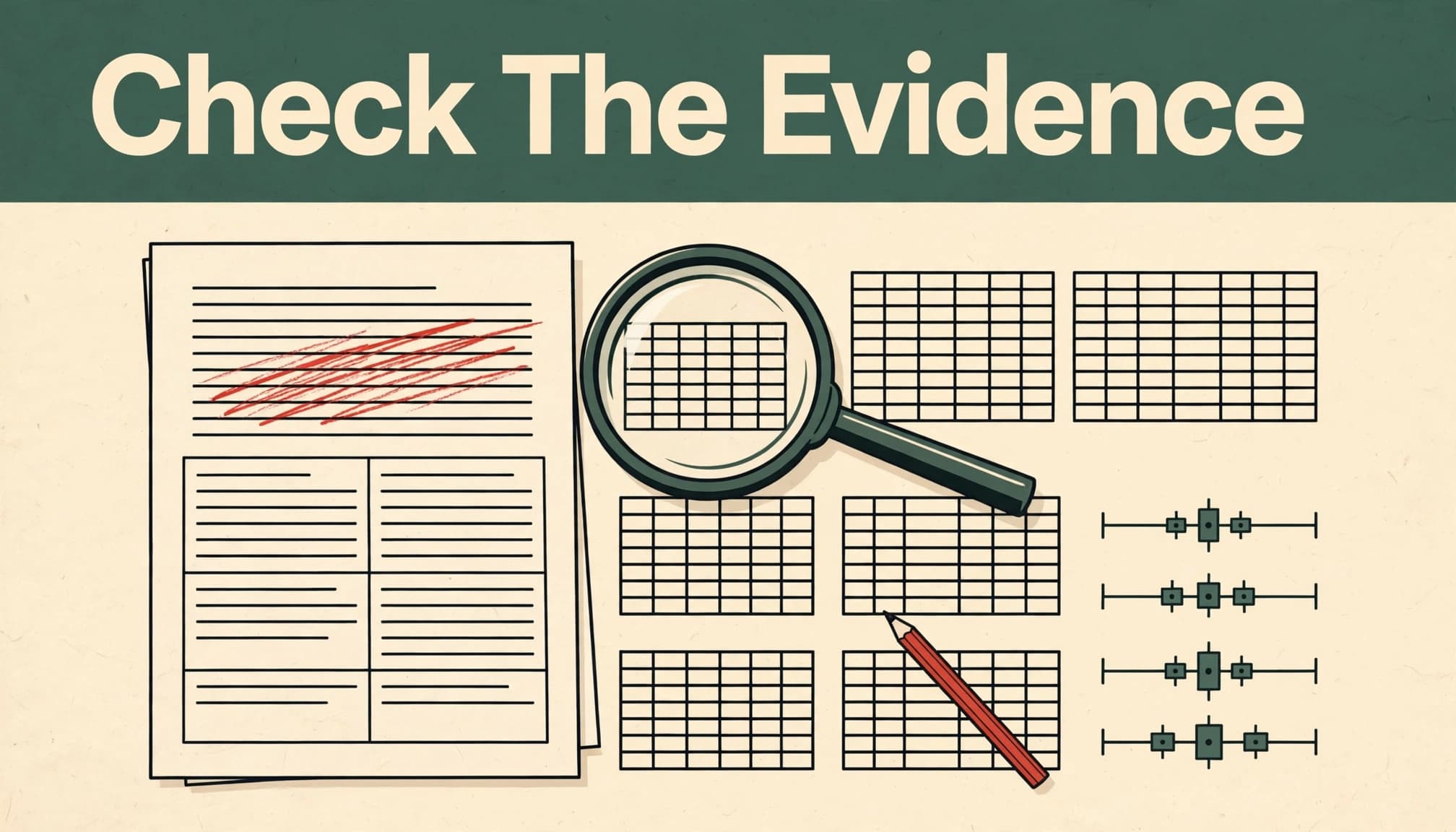
Read the Results section and tables together
Begin with the primary outcome, then locate its supporting table or figure. Confirm the direction of the effect, the comparison group, the sample analyzed, and the reported estimate.
A result may be statistically significant but small in practical terms. Conversely, a meaningful point estimate with a wide confidence interval may remain uncertain. The abstract should report the result in a way that lets readers see both the finding and its precision.
Look for qualifiers outside the headline result
Methods and limitations often contain details that change the right verb. Drafts produced by artificial intelligence tools may isolate the most favorable findings while dropping methodological boundaries. Cross-sectional studies cannot establish temporal order. Convenience samples may not represent the wider population. Short follow-up periods cannot establish durability.
Authors should also inspect subgroup analyses, missing-data handling, protocol deviations, and secondary outcomes. If an AI draft mentions only the most favorable result, the abstract may create an unbalanced record.
Replace Overstatement With Evidence-Matched Language
Careful language is not evasive language. It reports what the study found without claiming more than the design, sample, and analysis allow. Text produced by an abstract generator tool frequently introduces causal or definitive verbs that the evidence doesn't support.
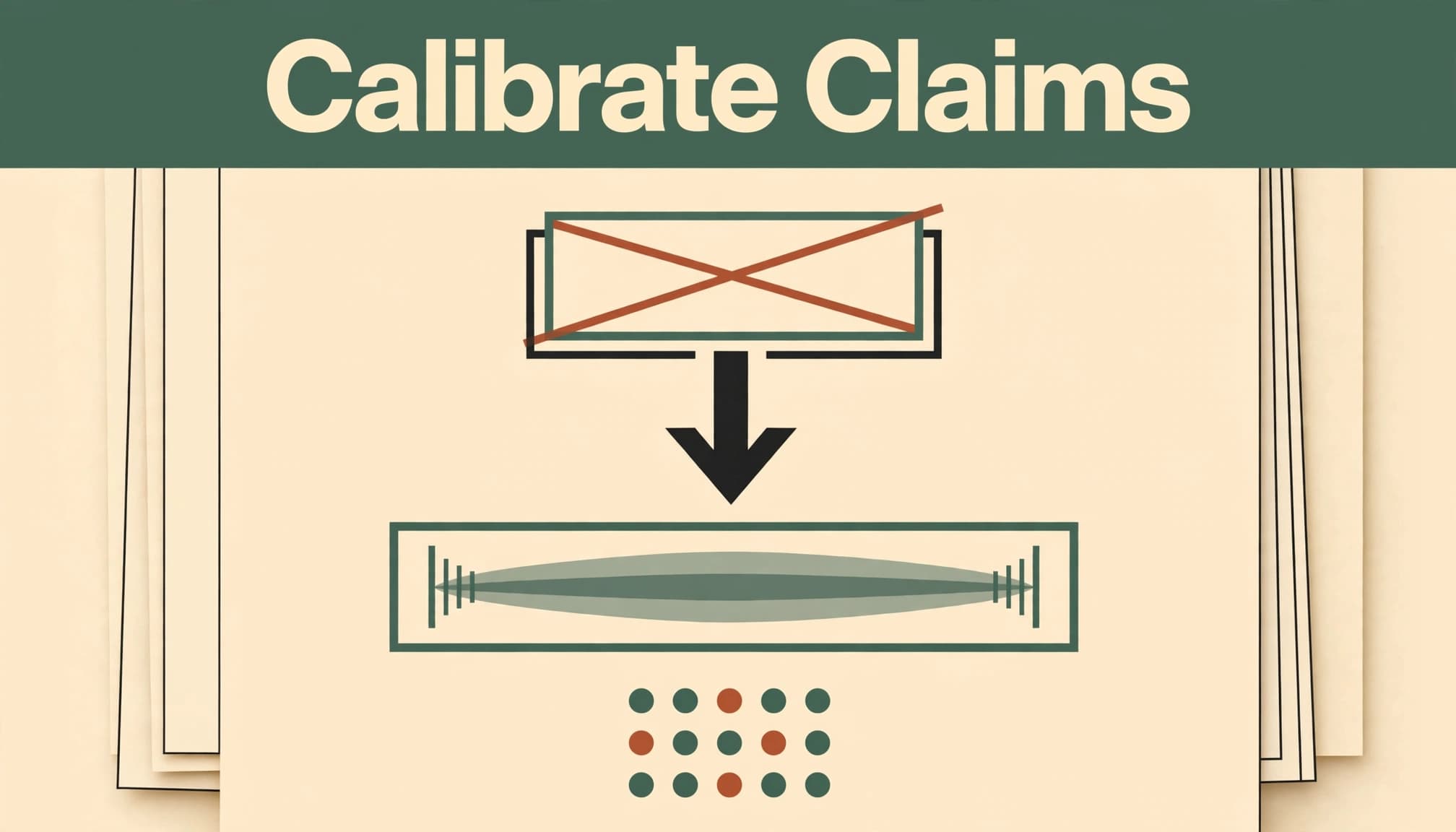
Use bracketed details only after confirming them in the paper.
Claim to remove | Evidence-matched revision | What to verify |
|---|---|---|
"[Intervention] caused better outcomes." | "In this randomized trial of [n] [population], [intervention] improved [outcome] by [effect size] at [time point]." | Randomization, outcome measure, effect estimate, follow-up |
"[Exposure] increases risk." | "In this observational study, [exposure] was associated with [outcome] after adjustment for [variables]." | Design, confounding controls, association estimate |
"The method works for everyone." | "Results apply to the [defined sample] and may not generalize to [unrepresented group or setting]." | Sampling frame, exclusions, setting |
"The findings prove the treatment is effective." | "The estimate favored [treatment], although the 95% confidence interval [included/excluded] no effect." | Confidence interval, prespecified outcome, uncertainty |
Match verbs to the design
Words such as "caused," "eliminated," "proved," and "demonstrated" deserve close scrutiny. They may be defensible in a well-executed experiment with a relevant outcome. They are usually too strong for observational data, exploratory analyses, surveys, or uncontrolled before-and-after studies.
Choosing evidence-matched verbs is a standard of scientific and professional writing. Use "was associated with," "participants reported," "the analysis estimated," or "results were consistent with" when those phrases better fit the evidence. These revisions preserve meaningful results instead of reducing every conclusion to vague language.
State uncertainty and limits where they matter
An abstract doesn't need every caveat in the manuscript. It must include limitations that could change a reader's understanding of the central result.
Artificial intelligence models routinely drop confidence interval widths and sample boundaries from summaries, so restore those details manually. Mention a wide confidence interval when precision is limited. Name a restricted sample when generalizability is narrow. If the study did not measure a claimed outcome, remove that implication. These choices protect readers from mistaking a preliminary estimate for a definitive answer.
Use AI as a Controlled Editing Tool
A text summarizer compresses supplied words, while an abstract generator tool can organize required elements and check whether each is supported. Neither process replaces scientific judgment.
Give the model bounded source material
Provide approved, non-confidential excerpts or a researcher-written evidence sheet rather than asking a public chatbot to interpret an entire unpublished manuscript. Apply disciplined prompt engineering to restrict the tool to verified evidence and prohibit invented statistics.
A useful prompt can request an abstract organized around objective, design, sample, primary outcome, effect estimate, limitation, and conclusion. It should also prohibit new statistics, citations, mechanisms, or recommendations.
Revise in small, traceable passes
Avoid sending several pages for a single rewrite. Smaller sections make it easier to compare altered verbs, numerical claims, citations, and qualifiers.
Modular revision preserves task efficiency while keeping changes easy to trace. Keep the original draft, the AI output, and the accepted revision. Version history and saved notes also help document human authorship and revision decisions, particularly for writers dealing with AI detector false positives. A detector score cannot establish authorship or research integrity.
Follow Publisher Rules on Generative AI
Journal policies differ in disclosure requirements and restrictions on research materials across scholarly publications. The target journal's current publisher guidelines take priority over general habits or a colleague's previous submission.
Elsevier and Nature Portfolio use different locations
Elsevier requires a separate declaration of generative AI use at the end of a manuscript, immediately before the references, when generative AI tools make substantive changes to content, organization, or sentence structure. Its updated generative AI policy also places responsibility for accuracy, bias, completeness, and fabricated references with the authors.
Nature Portfolio asks authors to document AI use in the Methods section, or another suitable section when Methods is absent. Its editorial policy on AI states that human authors remain accountable and that large language models don't meet authorship criteria.
Wiley separates writing assistance from research methods
Wiley's guidance places disclosure statements for drafting, editing, translation, or formatting assistance in the Acknowledgments. AI used in research methodology, data collection, analysis, or literature review belongs in Methods. For journal submissions, AI-generated or AI-edited visual material requires disclosure in figure captions under Wiley's AI guidelines for researchers.
These distinctions matter because an abstract produced from data analysis is different from an abstract whose grammar received light editing. Institutional requirements for thesis and dissertations can differ again, so graduate students should verify departmental guidelines.
Treat confidential material as off-limits unless approved
Unpublished findings, participant information, protected health information, proprietary datasets, and identifiable records should only be processed using an approved data-secure platform, not a public AI service. Removing a name may not remove identity when dates, rare conditions, locations, or linked details remain.
Approval, contract terms, access controls, and institutional privacy rules determine whether a system is suitable. General claims that an AI platform is secure don't settle that question.
Review Graphical Abstracts With the Same Care
Graphical abstracts can make a study easier to scan, but they can also turn a qualified result into a bold visual promise. An image that implies causation, universality, or clinical benefit can mislead, even if the text abstract is careful.
Elsevier prohibits AI-generated graphical abstracts. Nature Portfolio generally restricts AI-generated images and videos, with limited policy exceptions. Tools such as Gemini, Cyspace, or Canva shouldn’t be presumed acceptable for journal figures without checking the specific journal’s requirements.
Build visuals from verified study elements
When preparing graphical abstracts, authors must strictly depict the validated sample, intervention or exposure, comparator, primary outcomes, and study time frame. They shouldn’t add molecular pathways, causal arrows, or outcome claims the study didn’t establish.
Check the caption and disclosure
Text captions accompanying graphical abstracts mustn’t assert stronger claims than the manuscript. The caption should identify what was measured and use evidence-matched language. If AI edited or generated visual content, follow the journal’s disclosure location and wording requirements before submission.
Thoroughly vetting graphical abstracts helps ensure visual representations don’t overstate the study’s scientific conclusions.
A Final Review Before Submission
Before finalizing an abstract produced or revised with an abstract generator tool, an author who understands the study should perform a line-by-line verification. This rigorous pre-submission audit helps prevent uncalibrated claims in final journal submissions, with subject-matter review for specialized, clinical, legal, or technically complex topics.
Audit the abstract sentence by sentence
For each sentence, locate its supporting source in the full peer-reviewed paper. Check the research objective, methodology, sample, statistical result, confidence interval, citation, and limitation. Remove any statement that lacks a clear source.
Authors should recalculate reported percentages when possible and check that rounded values still agree with the tables. A polished abstract with one incorrect number can distort the paper's entire reception.
Confirm accountability and disclosure
The named authors must approve the final language and accept responsibility for each claim. Authors must prepare accurate disclosure statements detailing the tool, model, date, prompt purpose, and human review steps when AI materially assisted drafting or revision.
That audit trail makes disclosure more accurate and makes it easier to explain how the manuscript developed without confusing editing support with authorship.
Frequently Asked Questions
Can AI summarize a research article for an abstract?
An abstract generator tool can produce a preliminary summary if journal, institutional, and course rules allow it. However, every statement must be checked against the original article, especially the sample, methods, numerical findings, and limitations. AI summaries can omit qualifiers or combine separate findings into a stronger claim.
Should an abstract report every limitation?
No. Abstracts are short, so they should focus on limitations that materially affect interpretation. Restricted populations, short follow-up, uncertain estimates, and observational design often belong in the abstract when they limit causation or generalizability.
Can AI generate missing citations or statistics?
No. A language model can produce plausible but nonexistent references and unsupported figures. Reference managers and original publications should remain the source of record for bibliographic details, quoted language, and reported results.
The Standard Is Evidence, Not Fluency
An abstract earns trust when its precision matches the study behind it. Clear prose matters, but calibrated claims matter more.
AI can help organize and refine language. It cannot determine whether a conclusion is supported, whether a limitation changes the result, or whether a journal disclosure is complete. Those judgments remain with the authors who submit the work.